
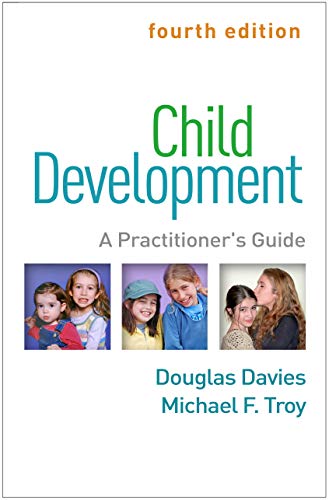
Child development : a practitioner's guide / Douglas Davies, Michael F. Troy ; Series Editor's Note by Nancy Boyd Webb.
Material type: TextSeries: Clinical practice with children, adolescents, and familiesPublisher: New York : The Guilford Press, [2020]Edition: Fourth editionDescription: xxiii, 512 pages ; 24 cmContent type:
 - text
- unmediated
- volume
- 9781462542994
- 155.4 DAV T 23
- HV713 .D375 2020
| Cover image | Item type | Current library | Home library | Collection | Shelving location | Call number | Materials specified | Vol info | URL | Copy number | Status | Notes | Date due | Barcode | Item holds | Item hold queue priority | Course reserves | |
|---|---|---|---|---|---|---|---|---|---|---|---|---|---|---|---|---|---|---|
| Stack text books | All India Institute of Speech and Hearing | 9/2 | 155.4 DAV T;1 (Browse shelf(Opens below)) | Available | 23265 | |||||||||||||
| Reference text books | All India Institute of Speech and Hearing | R-5/5 | 155.4 DAV T (Browse shelf(Opens below)) | Available | 22985 |
Includes bibliographical references (pages 441-496) and index.
I. Contexts of Development: A Transactional Approach
1. Attachment as a Context for Development
2. Brain Development
3. Risk and Protective Factors: The Child, Family, and Community Contexts
4. Analysis of Risk and Protective Factors: Practice Applications
II. The Course of Child Development
5. Infant Development
6. Practice with Infants
7. Toddler Development: Core Domains
8. Toddler Development: Integrated Domains
9. Practice with Toddlers
10. Preschool Development: Core Domains
11. Preschool Development: Integrated Domains
12. Practice with Preschoolers
13. Middle Childhood Development: Core Domains
14. Middle Childhood Development: Integrated Domains
15. Practice with School-Age Children
16. Conclusion: Developmental Knowledge and Practice
"This book describes child development and how it can be applied to practice with children. Developmental knowledge provides a framework for understanding children in relation to the tasks and issues relevant to their age. These, in turn, are determined by physical, social, emotional, and neurodevelopmental norms that transform in meaningful ways from birth through adolescence. Only with a sound grounding in this knowledge can we determine whether a child's emotions, thoughts, or behaviors fall within normal expectations. Part I, "Contexts of Development: A Transactional Approach," introduces the idea that the child's development is the outcome of the interplay of normative developmental maturation and the context within which it occurs. Part II, "The Course of Child Development," represents the core of the book, looking at childhood through the lens of discrete expected stages"-- Provided by publisher.
There are no comments on this title.