
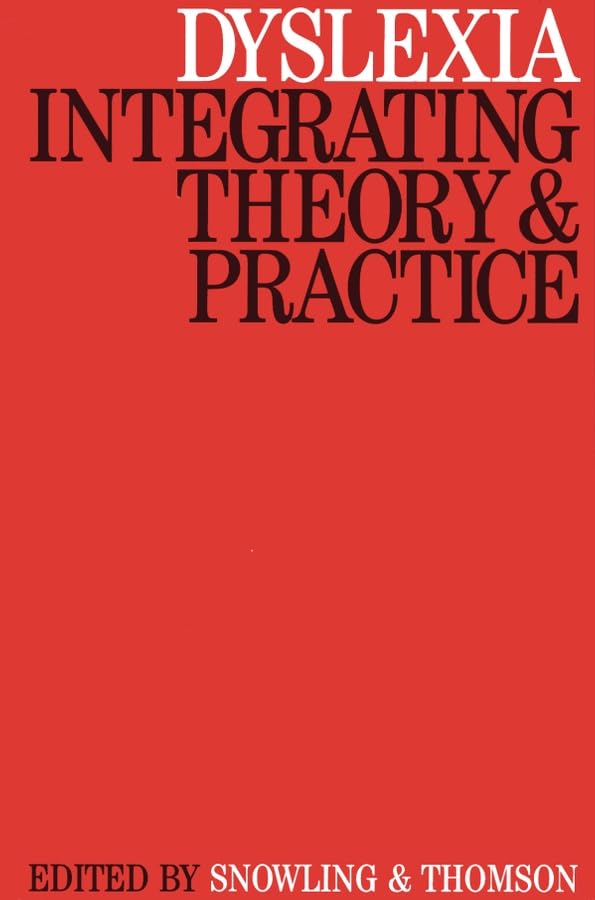
Dyslexia : integrating theory and practice : selected papers from the second International Conference of the British Dyslexia Association "Meeting the Challenge", Oxford, 1991 / edited by Margaret Snowling and Michael Thomson.
Material type: TextPublication details: London and New Jersey : Whurr Publishers, c1992.Description: xx, 332 p. : ill. ; 24 cmISBN:
 - 1870332474
- 616.8553 SNO T 20
- LC4710.G7 B75 1992
| Cover image | Item type | Current library | Home library | Collection | Shelving location | Call number | Materials specified | Vol info | URL | Copy number | Status | Notes | Date due | Barcode | Item holds | Item hold queue priority | Course reserves | |
|---|---|---|---|---|---|---|---|---|---|---|---|---|---|---|---|---|---|---|
| Stack text books | All India Institute of Speech and Hearing | 70/4 | 616.8553 SNO T (Browse shelf(Opens below)) | Available | 10276 |
Includes bibliographical references and index.
Contributors. Acknowledgements. Editorial. Part 1: Biological bases. Chapter 1 Genetics and Dyslexia: an overview -- John C.DeFries. Chapter 2 Neurobiological issues in dyslexia -- Drake D. Duane. Chapter 3 Vision and language -- John F. Stein. Chapter 4 EEG topographical mapping and laterality measures in dyslexic children -- Georgina Rippon. Part II: The normal development of literacy. Chapter 5 The development of reading and spelling in children: an overview -- Linnea Ehri. Chapter 6 Spelling and sound in learning to read -- Nick Ellis. Chapter 7 Metaphonological abilities and literacy -- Jose Morais. Chapter 8Recent work on reading and spelling development -- Usha Goswami. Part III: The definition, nature and prevalence of dyslexia. Chapter 9 The theoretical and practical consquences of discrepancy definitions of dyslexia -- Keith E. Stanovich. Chapter 10 On determining the prevalence of dyslexia -- Tim R. Miles. Chapter 11 Phonological and visual segmentation problems in poor readers -- Rhona Brown and Frances Watson. Part IV: Intervention: theoretical and practical issues. Chapter 13 Dyslexia: the obvious and hidden speech and language disorder -- Joy Stackhouse and Bill Wells. Chapter 14 Visual dyslexia/auditory dyslexia: is this a valuable distinction? -- Elaine Miles. Chapter 15 Is medicinal treatment of dyslexia advisable -- Colin Wilsher. Part V: Intervention: empirical studies of teaching. Chapter 16 The remediation of reading comprehension difficulties. Chapter 17 The beneficial effect of accelerating reading rate: on dyslexic readersa reading comprehension -- Zvia Breznitz. Chapter 18 The teaching of spelling using techniques of simultaneous oral spelling and visual inspection -- Michael Thomson. Part VI: Intervention: the practical skills of dyslexic teaching. Chapter 19 Factors to consider when designing a test protocol in mathematics for dyslexics -- Steve J Chinn. Chapter 20 Mathematics and dyslexics -- after basics what then? -- Anne Henderson. Chapter 21 Communication and study skills at primary level -- Patience Thomson. Chapter 22 Curriculum--based study skills -- Virginia Kelly. Chapter 23 The road to reading: basic skills to college allowances -- Arlene W. Sonday. Chapter 24 Setting up a learning programme for adult dyslexics -- Cynthia Klein. Chapter 25 The dyslexic childa s transfer of learning from the individual less to work in the classroom -- Ann Cooke. Chapter 26 The use of tape--recorders to develop speaking and listening skills -- Jeanne Reilly. Chapter 27 Pupila s self--evaluation as an aid to teaching handwriting -- Jane Taylor. Chapter 28 A multisensory approach towards reading music -- Margaret Hubicki. Index.
There are no comments on this title.