
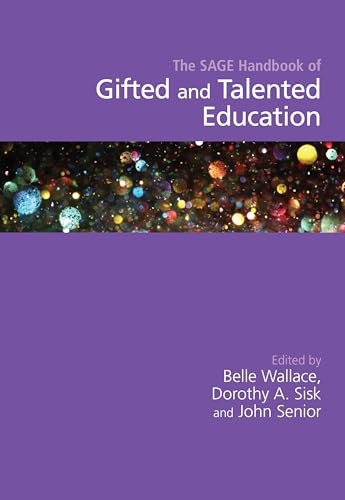
The Sage handbook of gifted and talented education / [edited by] Belle Wallace, Dorothy A. Sisk, John Senior.
Material type: TextPublisher: Thousand Oaks, CA : SAGE Inc., 2018Edition: 1st editionDescription: pages cmContent type:
 - text
- unmediated
- volume
- 9781526431158
- 371.95 WAL
| Cover image | Item type | Current library | Home library | Collection | Shelving location | Call number | Materials specified | Vol info | URL | Copy number | Status | Notes | Date due | Barcode | Item holds | Item hold queue priority | Course reserves | |
|---|---|---|---|---|---|---|---|---|---|---|---|---|---|---|---|---|---|---|
| Reference text books | All India Institute of Speech and Hearing | R-13/2 | 371.95 WAL (Browse shelf(Opens below)) | Available | 22146 |
Preface - Chris Yapp
General Introduction to the Handbook - Belle Wallace, Dorothy A. Sisk, and John Senior
SECTION 1: Concepts of Giftedness and Identification: Social and Emotional Needs
Introduction to Section 1 - Dorothy A. Sisk
Chapter 1: Is Gifted Education on the Right Path? - Robert J. Sternberg
Chapter 2: Spiritual Intelligence: Developing Higher Consciousness - Dorothy A. Sisk
Chapter 3: Exchanging Giftedness for a Better Gift - Janet E. Davidson
Chapter 4: Tapping the Untapped - Untold Stories: Revisiting the Concept of Giftedness through the Mirror of Multi-Cultural India - Krishna Maitra and Yukti Sharma
Chapter 5: Honoring Differences: Improving the Representation of Culturally Different Gifted Students based on Equity - Donna Y. Ford, Ramon B. Goings, Jemimah L. Young, and Brian L. Wright
Chapter 6: Creativity and Genius - Dean Keith Simonton
Chapter 7: Why Bother Being Different? The Role of Intrinsic Motivation in Creativity - Kelsey Procter Finley and Mihaly Csikszentmihalyi
Chapter 8: New Dynamic Approach to Measure Creativity: Implications for Indentification and Education - Taisir Subhi Yamin
Chapter 9: Profoundly Gifted: Outliers among the Outliers - Stephanie Tolan
Chapter 10: Eminence in Talented Women by Domain: Issues, Similarities, and Differences Utilizing the Piirto Pyramid as a Theoretical Framework - Jane Piirto
Chapter 11: Accepting Exceptionality: Giftedness and ADHD - Kelly M. Lee and F. Richard Olenchak
Chapter 12: Hidden Treasures: Twice Exceptional Students - Linda Kreger Silverman
Chapter 13: Serving and Honoring Gender Diversity in Education - Robert W. Seney
Chapter 14: The Emotional Development of the Gifted and Talented - Joan Freeman
Chapter 15: Friendships of Gifted Children and Youth: Updated Insights and Understanding - Bruce M. Shore, Tanya Chichekian, Petra D.T. Gyles, and Cheryl L. Walker
Chapter 16: Parental Influence on Perfectionism among Chinese Gifted Children in Hong Kong - Lai-kwan Chan
SECTION 2: Educational Provision: Programs and Strategies
Introduction to Section 2 - Belle Wallace
Chapter 17: Building Knowledge Bridges: Synthesising early years and gifted education research and practice to provide an optimal start for young gifted children - Margaret Sutherland and Niamh Stack
Chapter 18: Engineering the Schoolwide Enrichment Model: A Case Study of the Process of Change in Education - Joseph S. Renzulli and Sally M. Reis
Chapter 19: TASC: Thinking Actively in a Social Context: a universal Framework for Developing Thinking Skills and Problem-solving Across the Curriculum - Belle Wallace and Harvey B. Adams
Chapter 20: Real Engagement in Active Problem Solving: An International Collaboration - C. June Maker and Randy Pease
Chapter 21: Designing Dynamic Learning Spaces for Gifted Learners: Authentic, Augmented and Actualized Places and Placements - Gillian Eriksson
Chapter 22: How to Create and Sustain a Culture of Excellence that benefits Highly Able Students to enter Top Research Universities - Ian Warwick
Chapter 23: Meta-analysis of 26 Forms of Academic Acceleration: Options for Elementary (Primary) and Secondary Learners with Gifts or Talents - Karen B. Rogers
Chapter 24: What works better than the rest? The impact of various curricula provisions for gifted learners - Janna Wardman and John Hattie
Chapter 25: Continuum of Differentiation - Sandra N. Kaplan
Chapter 26: The National Mentoring program in Israel: A model for developing leadership among highly gifted students - Rachel Zorman, Menachem Nadler, Pnina Zeltser, and Zipi Bashan
Chapter 27: Capacities, Challenges, and Curriculum for Australian learners with exceptional potential for English-language learning - Aranzazu M. Blackburn and Susen R. Smith
Chapter 28: Career-life counselling for the gifted in sub-Saharan Africa - Jacobus G. Maree
Chapter 29: Recognizing, Developing and Offering Talents as Educational Gifts through Living Theory Research - Jack Whitehead and Marie Huxtable
Section 3: Global Responses to Emerging G&T Provision: Defining the Future
Introduction to Section 3 - John Senior
Chapter 30: The Education of Highly Able Children in England: Challenges and Achievements - Hilary Lowe
Chapter 31: Creativity Competition for Gifted Students' Communication and Self-Esteem Development - Finarya Legoh
Chapter 32: Gifted Education in Brazil: Historical Background, Current Practices and Research Trends - Eunice M.L. Soriano de Alencar, Denise de Souza Fleith, and Liliane Bernades Carneiro
Chapter 33: New Century Gifted Education in Mainland China - Jiannong Shi and Pin Li
Chapter 34: Gifted Education in Asia: Vision and Capacity - David Yun Dai
Chapter 35: Developments and Issues of Gifted Education in Taiwan - Ching-Chih Kuo
Chapter 36: Development of Gifted Education in Turkey - Ugur Sak, Bahadir Ayas, Bilge Bal-Sezerel, N. Nazli OEzdemir, Ercan OEpengin & Sule Demirel
Chapter 37: Gifted Education in Europe - Andrzej E. Sekowski, Barbara Cichy-Jasiocha, Martyna Pludowska
Chapter 38: Giftedness in a Context of 21st-Century Globalization - Don Ambrose
Chapter 39: The creative being and being creative: human machine neural networks - Eva Gyarmathy
Chapter 40: Gifted Education: The Future Awaits - Ken McCluskey
Conclusion - Belle Wallace, Dorothy A. Sisk, and John Senior
There are no comments on this title.