
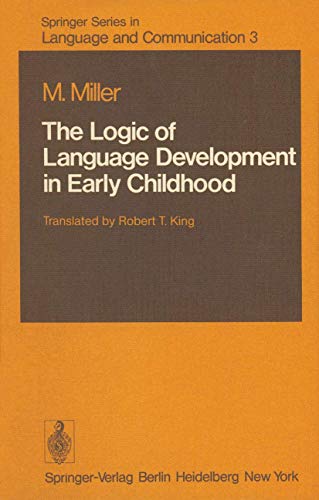
The logic of language development in early childhood / Max Miller ; translated by Robert T. King.
Material type: TextLanguage: engger Series: Springer series in language and communication ; v. 3Publication details: Berlin ; New York : Springer-Verlag, 1979.Description: xvi, 478 p. ; 24 cmISBN:
 - 9783642674105
- 401.93 MIL
- P118 .M513
| Cover image | Item type | Current library | Home library | Collection | Shelving location | Call number | Materials specified | Vol info | URL | Copy number | Status | Notes | Date due | Barcode | Item holds | Item hold queue priority | Course reserves | |
|---|---|---|---|---|---|---|---|---|---|---|---|---|---|---|---|---|---|---|
| Stack text books | All India Institute of Speech and Hearing | 31/3 | 401.93 MIL (Browse shelf(Opens below)) | Available | 7922 |
Translation of Zur Logik der frühkindlichen Sprachentwicklung.
Includes indexes.
Bibliography: p. 461-470.
1 Introduction.- 2 Description of the Project: Cognitive and Social Determinants of Language Acquisition.- 2.1 General and Long-Term Goals of the Language Acquisition Project.- 2.2 The Children under Observation: Meike, Kerstin, and Simone.- 2.2.1 Social Data.- 2.3 The Method of Gathering Data.- 2.3.1 Tape Recordings.- 2.3.2 Transcriptions.- 3 A Quantitative Analysis of the Early Linguistic Development of Meike and Simone.- 3.1 A Survey of the Individual Corpora of Utterances of Meike and Simone.- 3.2 Quantitative Features of Corpora I to III for Meike and Simone.- 3.2.1 MLU Values.- 4 Problems in the Transformational Analysis of Early Child Language.- 4.1 The Pivot-Grammar Approach.- 4.1.1 Characteristics of the Pivot-Grammar Approach.- 4.1.2 Criticism of the Pivot-Grammar Approach.- a) Distributional Evidence for Pivot Grammar.- b) The Universality of Pivot Grammar.- 4.2 Empirical Arguments for a Transformational Descriptive Model.- 4.2.1 The Descriptive Inadequacy of a Phrase Structure Grammar.- 4.2.2 Constructional Homonyms.- 4.3 The Method of Rich Interpretation.- 4.3.1 Semantic Analyses of Early Child Language.- 4.3.2 Discovery Procedures.- 4.4 Reduction Transformations.- 4.4.1 The Definition and Description of Reduction Transformations.- 4.4.2 Criticism of Reduction Transformations.- 5 Aspects of the Early Linguistic Development of Meike and Simone.- 5.1 A Sketch of a Model for the Description of a Child's Communicative Intentions.- 5.2 Illocutionary Acts and Terminal Intonation Contours.- 5.2.1 Preliminary Considerations.- 5.2.2 A Model for the Description of Terminal Intonation Contours in Adult Language.- 5.2.3 The Ontogenesis of Terminal Intonation Contours.- 5.2.4 Some Contrasting Arguments on the Role of Terminal Intonation Contours at the Stage of One-Word Utterances.- 5.2.5 A Description of the Terminal Intonation Contours of Meike and Simone.- 5.2.6 A Reliability Test of the Description of Terminal Intonation Contours.- 5.2.7 Correspondence between Terminal Intonation Contours and Types of Illocutionary Acts in the Utterances of Meike and Simone.- 5.3 Propositional Acts and Word Order.- 5.3.1 Preliminary Considerations.- 5.3.2 The Semantics of One-Word Utterances.- 5.3.3 Semantic Versus Syntactic Relations.- 5.3.4 The System of Semantic Relations in Early Child Language.- a) The Definition and Formal Representation of Semantic Relations.- b) The Logical Structure of Semantic Relations.- c) The Form of the Realization Rules.- d) A Description of the Semantic Relations of Early Child Language.- e) "Referential Operations".- f) A Description of "Referential Operations" as Predicates and as Forms of Deictic Reference.- 5.3.5 A Tabulated Survey of the Semantic Construction Types (SKT's) used by Meike and Simone.- 5.3.6 Word Order in Meike's and Simone's Utterances.- a) Word Order in Two-Word Utterances.- b) Word Order in Three-Word and Four-Word Utterances.- c) Discussion of the Results Concerning Word Order in the Utterances of Meike and Simone.- 5.3.7 Word Order in Child Language and Adult Language.- 5.4 Context-Referential Acts and Ellipsis.- 5.4.1 Preliminary Considerations.- 5.4.2 The Communicative Egocentrism of the Child.- 5.4.3 Deixis and Communicative Egocentrism.- 5.4.4 Gestural and Symbolical Use of Deixis.- 5.4.5 Place Deixis.- 5.4.6 Time Deixis.- 5.4.7 Person Deixis.- 5.4.8 Implicit Reference by Means of Illocutionary Acts and Interactional Routines.- 5.4.9 Contextual Alternatives and Constructional Problems for the Child.- 6 Conclusion.- 6.1 Summary.- 6.1.1 Semantic Relations and Sensorimotor Intelligence.- 6.1.2 Pragmatic Conventions and Communicative Egocentrism.- 6.2 Final Comments on the Logic of Language Development in Early Childhood.- 7 Appendix.- 7.1 Glossary of the Notations Used in the Transcripts.- 7.2 Context of Items Used in the Intonation Test.- 7.3 Context of Items Used in the Semantic and Pragmatic Analysis.- Meike SKT 1.- Simone SKT 1.- Meike SKT 2.- Simone SKT 2.- Meike SKT 3.- Simone SKT 3.- Mei ke SKT 4-6.- Simone SKT 4-6.- Meike SKT 7.- Simone SKT 7.- Meike SKT 8.- Simone SKT 8.- Meike SKT 9.- Simone SKT 9.- Meike SKT 10.- Simone SKT 10.- Meike SKT 11.- Simone SKT 11.- Meike SKT 12.- Simone SKT 12.- Meike SKT 13.- Simone SKT 13.- References.- Author Index.
There are no comments on this title.