
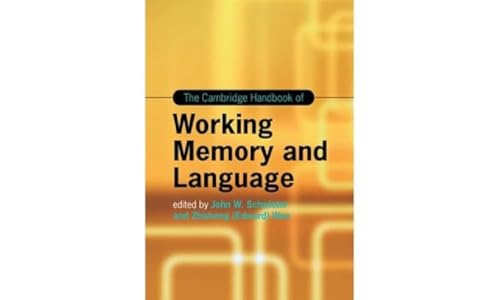
The Cambridge handbook of working memory and language / edited by John W. Schwieter, Wilfrid Laurier University, Ontario ; Edward Z.S. Wen, Macao Polytechnic Institute.
Material type: TextSeries: Cambridge handbooks in language and linguisticsPublisher: Cambridge ; New York, NY : Cambridge University Press, 2022Description: 939pContent type:
 - text
- unmediated
- volume
- 9781108958110
- 401.93 SCH W 23/eng/20220113
| Cover image | Item type | Current library | Home library | Collection | Shelving location | Call number | Materials specified | Vol info | URL | Copy number | Status | Notes | Date due | Barcode | Item holds | Item hold queue priority | Course reserves | |
|---|---|---|---|---|---|---|---|---|---|---|---|---|---|---|---|---|---|---|
| Reference text books | All India Institute of Speech and Hearing | R-15/4 | 401.93 SCH W (Browse shelf(Opens below)) | Available | 24024 |
Includes bibliographical references and index.
1. Working memory and language: an overview of key topics
Part I. Introduction:
2. Working memory and the challenge of language
Part II. Theoretical Models and Measures:
3. The evolution of working memory and language
4. The phonological loop as a 'language learning device': an update
5. The Embedded-Processes Model and language use
6. Long-term working memory and language comprehension
7. The cognitive neuroscience of working memory and language
8. Computational models of working memory for language
9. The time-based resource sharing model of working memory for language
10. The Ease of Language Understanding Model
11. Assessing children's working memory
12. Measuring individual differences in working memory capacity and attention control and their contribution to language comprehension
Part III. Linguistic Theories and Frameworks:
13. Have grammars been shaped by working memory and if so, how?
14. Branching and working memory: a cross-linguistic approach
15. Working memory and natural syntax
16. The role of working memory in shaping syntactic dependency structures
17. Working memory in the Modular Cognition Framework
18. Short-term and working memory capacity and the language device: chunking and parsing complexity
Part IV. First Language Processing:
19. Working memory in word reading
20. The role of working memory in language comprehension and production: evidence from neuropsychology
21. Working memory and high-level text comprehension processes
22. Working memory and speech planning
23. How do novice and skilled writers engage working memory?
Part V. Bilingual Acquisition and Processing:
24. How measures of working memory relate to L2 vocabulary
25. Working memory and L2 grammar development in children
26. Working memory and L2 grammar learning among adults
27. Working memory and L2 sentence processing
28. Methodological issues in research on working memory and L2 reading comprehension
29. Working memory and second language speaking tasks
30. Working memory in second language interaction
31. Working memory and interpreting studies
32. A methodological synthesis of working memory tasks in L2 research
Part VI. Language Disorders, Interventions, and Instruction:
33. Specific learning disorders as a working memory deficit
34. A new perspective on the connection between memory and sentence comprehension in children with developmental language disorder
35. Working memory and childhood deafness
36. Working memory training in the classroom
37. Working memory and classroom learning
38. Cognitive load theory and instructional design for language learning
39. Working memory training: meta-analyses and clinical implications
Part VII. Conclusion:
40. Towards an integrated account of working memory and language
Index.
"Bringing together cutting-edge research, this Handbook is the first comprehensive text to examine the pivotal role of working memory in first and second language acquisition, processing, impairments, and training. Authored by a stellar cast of distinguished scholars from around the world, the Handbook provides authoritative insights on work from diverse, multi-disciplinary perspectives, and introduces key models of working memory in relation to language. Following an introductory chapter by working memory pioneer Alan Baddeley, the collection is organized into thematic sections that discuss working memory in relation to: Theoretical models and measures; Linguistic theories and frameworks; First language processing; Bilingual acquisition and processing; and Language disorders, interventions, and instruction. The Handbook is sure to interest and benefit researchers, clinicians, speech therapists, and advanced undergraduate and postgraduate students in linguistics, psychology, education, speech therapy, cognitive science, and neuroscience, or anyone seeking to learn more about language, cognition and the human mind"-- Provided by publisher.
There are no comments on this title.