
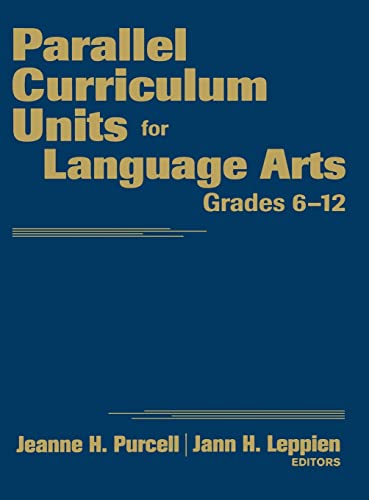
Parallel curriculum units for language arts, grades 6-12 / Jeanne H. Purcell, Jann H. Leppien, editors.
Material type: TextPublication details: Thousand Oaks, Calif. : Corwin, c2009.Description: viii, 220 p. : ill. ; 28 cmISBN:
 - 9781412965378 (cloth)
- 9781412965385 (pbk.)
- 1412965373 (cloth)
- 1412965381 (pbk.)
- 372.6 PUR L 22
- LB1631 .P25 2009
| Cover image | Item type | Current library | Home library | Collection | Shelving location | Call number | Materials specified | Vol info | URL | Copy number | Status | Notes | Date due | Barcode | Item holds | Item hold queue priority | Course reserves | |
|---|---|---|---|---|---|---|---|---|---|---|---|---|---|---|---|---|---|---|
| Stack text books | All India Institute of Speech and Hearing | 27/2 | 372.6 PUR L (Browse shelf(Opens below)) | Available | 17092 |
Browsing All India Institute of Speech and Hearing shelves,Collection: 27/2 Close shelf browser (Hides shelf browser)


Includes bibliographical references and index.
About the Editors
About the Contributors
Introduction to the Parallel Curriculum Model
1. Understanding and Finding Your Author's Voice: An Intermediate Language Arts Unit (Grades 6-7)
Introduction to the Unit - Lee-Ann Hayen
Content Framework - Judy Walsh
Assessments - Judy Walsh
Unit Sequence, Description, and Teacher Reflections
Lesson 1.1: The Contributors to Identity
Lesson 1.2: Shaping Your Voice
Lesson 1.3: The Influences on Mood
Lesson 1.4: Analyzing an Author's Voice
Lesson 1.5: Finding the Right Voice and Mood for Your Purpose
Lesson 1.6: Your Turn
2. The LIttle Napoleon in Us All: Literary Criticism and the Battle for Power (Grade 8)
Introduction to the Unit
Content Framework
Assessments
Unit Sequence, Description, and Teacher Reflections
Lesson 2.1: Preassessment/Brainstorming
Lesson 2.2: What Is Allegory?
Lesson 2.3: Diary of an Author
Lesson 2.4: Write a Personal Allegory
Lesson 2.5: Character Analysis, Part I
Lesson 2.6: Orwell's Responsibility
Lesson 2.7: Literary Criticism
Lesson 2.8: WRite a Literary Critique of Animal Farm
Lesson 2.9: Character Analysis Map, Part II
Lesson 2.10: What Is a Classic?
Lesson 2.11: Survivor: The Isms
Lesson 2.12: Final Assessment
3. Reacting to a Literary Model: Writing Original Pieces (Grades 9-10)
Introduction to the Unit
Content Framework
Assessments
Unit Sequence, Description, and Teacher Reflections
Lesson 3.1: Preassessment
Lessons 3.2 and 3.3: Setting and Mood
Lessons 3.4 and 3.5: Creating Realistic Characters
Lessons 3.6 and 3.7: Prejudice, Conflict, and Theme
Lesson 3.8: Postassessment
4. You Be the Critic: Understanding, Using, and Writing Literary Criticism (Grades 11-12)
Introduction to the Unit
Content Framework
Assessments
Unit Sequence, Description, and Teacher Reflections
Lesson 4.1: Introduction to Literary Criticism
Lesson 4.2: Analyzing a Fictional passage for Content
Lessons 4.3, 4.4, and 4.5: Character Development and Point of View
Lessons 4.6 and 4.7: Understanding Tone
Lessons 4.8 and 4.9: What Is Style?
Lesson 4.10: Recognizing Style
Lesson 4.11: Rhetoric and Rhetorical Devices
Lessons 4.12 and 4.13 The Persuasive Essay and the Editorial
Lessons 4.14 and 4.15: Writing a Literary Analysis
There are no comments on this title.