
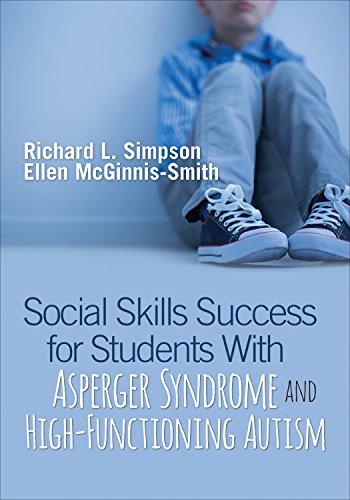
Social skills success for students with Asperger syndrome and high-functioning autism / Richard L. Simpson, Ellen McGinnis-Smith.
Material type: TextPublisher: Thousand Oaks, California : Corwin, A SAGE Publishinng Company, 2018Description: xx, 210 pages : illustrations ; 26 cmContent type:
 - text
- unmediated
- volume
- 9781544320502 (pbk. : alk. paper)
- 371.94 SIM M 23
- LC4717.5 .S47 2018
| Cover image | Item type | Current library | Home library | Collection | Shelving location | Call number | Materials specified | Vol info | URL | Copy number | Status | Notes | Date due | Barcode | Item holds | Item hold queue priority | Course reserves | |
|---|---|---|---|---|---|---|---|---|---|---|---|---|---|---|---|---|---|---|
| Reference text books | All India Institute of Speech and Hearing | R-13/2 | 371.94 SIM M (Browse shelf(Opens below)) | Available | 22323 |
Browsing All India Institute of Speech and Hearing shelves,Collection: R-13/2 Close shelf browser (Hides shelf browser)


Includes bibliographical references and index.
Preface
Publisher's Acknowledgments
About the Authors
Chapter 1. Understanding Asperger Syndrome and High-Functioning Autism
Autism Spectrum Disorders
Children and Youth With Asperger Disorder and Other Types of High-Functioning Autism
Social Skill and Social Interaction
Physical and Motor Skill Challenges
Case Example: Stanley
Prevalence
Summary Considerations
References
Chapter 2. Social Challenges and Foundations for Successful Outcomes
Justification for Social Skill Instruction
Challenges to Social Skill Instruction
Strategies for Teaching Social Skills to Children and Youth With HF/AD
A Foundation for Social Skill Instruction
Social Skill Instructional Targets
Summary Considerations
References
Chapter 3. Social Skill and Support Methods for Learners With Asperger Disorder and High-Functioning Autism
Fundamental Instructional Methods for Children With High-Functioning Autism
Social Skill Instructional Steps for Building Social Skill Capacity and Social Interaction Competency
Summary Considerations
References
Examples: Social Skill Instructional Targets, Skill Development Steps, and Evaluation
Chapter 4. Sample Social Skill Development Program
Case Example: Jackson
Category 1: Fundamental Social Interaction, Social Relationship, and Collaboration Skill Sample Program
Category 2: Self-Advocacy, Self-Management, and Personal Accountability Sample Program
Category 3: School-Related Social Skills Sample Program
Summary Considerations
References
Chapter 5. Generalizing Social Skills: Challenges and Strategies
Planning for Skill Generalization and Transfer
Planning for Skill Generalization: Role-Playing and Practice
Planning for Skill Generalization: Coaching and Performance Feedback
Planning for Skill Generalization: Practice and Skill Rehearsal in Everyday Settings
Summary Considerations
References
Chapter 6. Supports for Structuring, Organizing, and Managing Social Learning
Supporting and Supporting and Promoting Acquisition and Performance of New Social Skills and Developing Social Interaction Competence
Environmental Modifications and Structuring Procedures
Social Skill Instructional Support Methods
Summary Considerations
References
Chapter 7. Peer Supports
Creating a Foundation of Social Acceptance and Positive Attitudes
Positive Experiences
Peer Recruitment
Using Peers to Create and Display Appropriate Models of Target Skills
Peer Involvement in Role-Play and Practice
Peer Involvement in Coaching and Performance Feedback
Peer Involvement in Assisting Learners to Practice, Rehearse, and Generalize Social Skills in Natural Settings
Summary Considerations
References
Chapter 8. Parent and Family Involvement and Support
Communication and Collaboration
Facilitating Ongoing Communication, Information Exchange, and Collaborative Relationships
Building Partnership and Skill Development and Support Relationships With Parents and Families
Selecting Levels and Types of Parent/Family Involvement
Summary Considerations
References
Index
There are no comments on this title.