
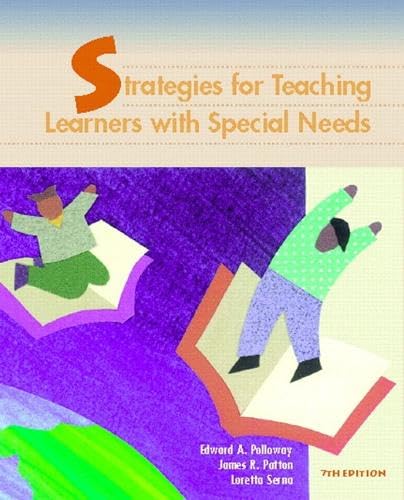
Strategies for teaching learners with special needs / Edward A. Polloway, James R. Patton, Loretta Serna.
Material type: TextPublication details: Upper Saddle River, N.J. : Merrill/Prentice Hall, c2001.Edition: 7th edDescription: xi, 611 p. : ill. ; 24 cmISBN:
 - 0130274305
- 371.9 POL 21
- LC4631 .P65 2001
| Cover image | Item type | Current library | Home library | Collection | Shelving location | Call number | Materials specified | Vol info | URL | Copy number | Status | Notes | Date due | Barcode | Item holds | Item hold queue priority | Course reserves | |
|---|---|---|---|---|---|---|---|---|---|---|---|---|---|---|---|---|---|---|
| Stack text books | All India Institute of Speech and Hearing | 18/2 | 371.9 POL (Browse shelf(Opens below)) | Available | 12768 |
Includes bibliographical references (p. 547-587) and indexes.
PART I. TEACHING LEARNERS WITH SPECIAL NEEDS.
1. Education for Learners with Special Needs.
2. Strategies for Classroom Management: Organization and Planning.
3. Strategies for Classroom Management: Behavior Change Strategies.
4. Effective Instructional and Accommodative Practices.
5. Strategies for Collaboration.
PART II. CURRICULUM.
6. Strategies for Curriculum Development and Program Design.
7. Spoken Language.
8. Reading: Introduction and Word Recognition.
9. Reading: Comprehension.
10. Written Language.
11. Mathematics.
12. Science and Social Studies.
13. Study Skills.
14. Social Competence and Self-Determination Skills.
15. Creative Arts: Visual Arts, Music, Dance, and Drama.
16. Transitions, Transition Planning, and Life Skills Education.
There are no comments on this title.