
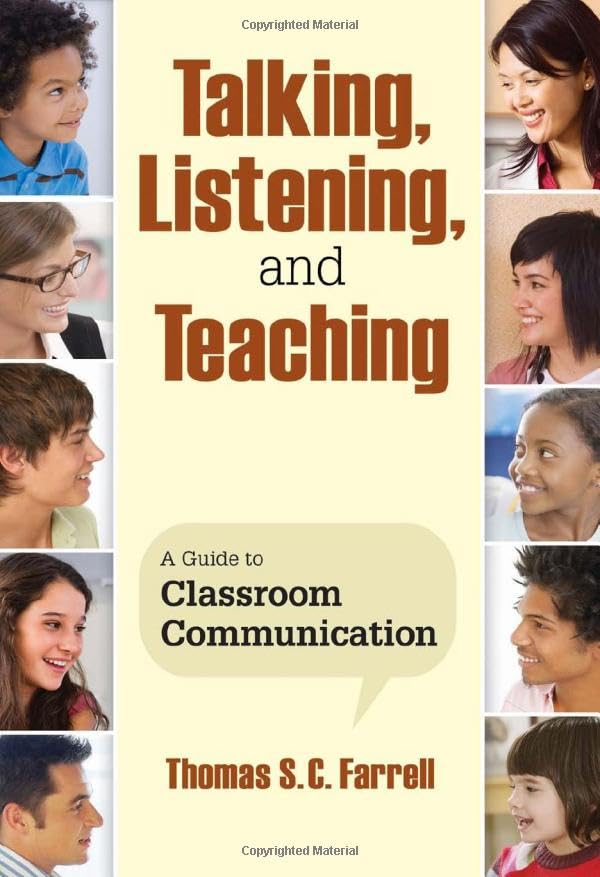
Talking, listening, and teaching : a guide to classroom communication / Thomas S.C. Farrell.
Material type: TextPublication details: Thousand Oaks, Calif. : Corwin, c2009.Description: xi, 106 p. ; 23 cmISBN:
 - 9781412962698 (pbk.)
- 1412962692 (pbk.)
- 371.102 2 FAR 23
- LB1033.5 .F37 2009
| Cover image | Item type | Current library | Home library | Collection | Shelving location | Call number | Materials specified | Vol info | URL | Copy number | Status | Notes | Date due | Barcode | Item holds | Item hold queue priority | Course reserves | |
|---|---|---|---|---|---|---|---|---|---|---|---|---|---|---|---|---|---|---|
| Stack text books | All India Institute of Speech and Hearing | 15/4 | 371.102 2 FAR (Browse shelf(Opens below)) | Available | 17105 |
Includes bibliographical references and index.
Preface
Acknowledgments
About the Author
1. Talking, Listening, Teaching: Understanding Classroom Communication
Mary's Class: An Illustration
What Is Communication?
What Is Classroom Communication?
Talking and Listening
A Framework for Understanding Classroom Communication
Studying Communication Patterns
Reflecting on Classroom Communication
2. I Treat Them All the Same: Supporting Classroom Communicative Competence
"I Treat Them All the Same"
What Is Classroom Communicative and Interactional Competence
Home and School Communication Differences
Gender Differentiation
Communication Apprehension
Reflecting on Classroom Communicative Competence
3. You Talk Like a Teacher: Collecting and Analyzing Classroom Communication
Basic Classroom Communication Structure
Variability in Classroom Communication Structure
How to Examine Classroom Communication Patterns
Reflecting on Classroom Communication Data
4. Why Don't They Do What I Ask? Developing Effective Classroom Participation
A Bad Beginning
Organizing Effective Classroom Participation
Teacher Talk
Reflecting on Effective Classroom Participation
5. What Is 2+2? Examining Teachers' Questions
Informant Questioning Strategies
Types of Teacher Questions
Ways of Directing Questions
Characteristics of Good Teacher Questions
Characteristics of Unproductive Questions
Teacher Wait-Time
Reflecting on Teachers' Questions
6. OK! Good! Exploring Teacher Feedback
Purposes of Teacher Feedback
Teacher Feedback Strategies
Unproductive Teacher Feedback
Reflecting on Teacher Feedback
7. Two Heads Are Better Than One: Utilizing Learner Groupings
Turn Allocation in Whole-Class Grouping
Small Groups/Pairwork
Making Groups Work
Reflecting on Learner Groupings
8. I See What You're Saying: Recognizing Nonverbal Communication in the Classroom
Functions of Nonverbal Communication
Types of Nonverbal Communication
Teachers' Use of Nonverbal Behaviors in the Classroom
Reflecting on Nonverbal Communication
9. Professional Development: Reflecting on Classroom Communication and Interaction
Reflective Practice as Professional Development
Thinking About Your Own Classroom
Reflecting on Classroom Communication and Interaction
References
Index
There are no comments on this title.