
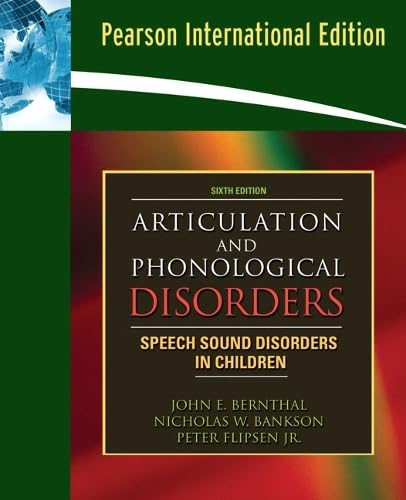
Articulation and phonological disorders : speech sound disorders in children / John E. Bernthal, Nicholas W. Bankson, Peter Flipsen JR.,
Material type: TextPublisher: Boston : Pearson, [2009]Copyright date: ©2009Edition: Sixth editionDescription: x, 468 pages : illustrations ; 29 cmContent type:
 - text
- unmediated
- volume
- 0205658180
- 9780205569267
- 618.92855 BER 23
- RC424.7 .B47 2017
| Cover image | Item type | Current library | Home library | Collection | Shelving location | Call number | Materials specified | Vol info | URL | Copy number | Status | Notes | Date due | Barcode | Item holds | Item hold queue priority | Course reserves | |
|---|---|---|---|---|---|---|---|---|---|---|---|---|---|---|---|---|---|---|
| Stack text books | All India Institute of Speech and Hearing | 99/1 | 618.92855 BER (Browse shelf(Opens below)) | Available | 18248 | |||||||||||||
| Reference text books | All India Institute of Speech and Hearing | R-62/2 | 618.928 55 BER (Browse shelf(Opens below)) | Available | 18252 | |||||||||||||
| Reference text books | All India Institute of Speech and Hearing | R-62/2 | 618.928 55 BER (Browse shelf(Opens below)) | Available | 16112 | |||||||||||||
| Reference text books | All India Institute of Speech and Hearing | R-62/2 | 618.928 55 BER (Browse shelf(Opens below)) | Available | 15980 | |||||||||||||
| Stack text books | All India Institute of Speech and Hearing | 99/1 | 618.92855 BER (Browse shelf(Opens below)) | Available | 18249 | |||||||||||||
| Stack text books | All India Institute of Speech and Hearing | 99/1 | 618.92855 BER (Browse shelf(Opens below)) | Available | 18250 | |||||||||||||
| Stack text books | All India Institute of Speech and Hearing | 99/1 | 618.92855 BER (Browse shelf(Opens below)) | Available | 18251 | |||||||||||||
| Stack text books | All India Institute of Speech and Hearing | 99/1 | 618.92855 BER (Browse shelf(Opens below)) | Available | 16111 |
Includes bibliographical references (pages 334-368) and index.
ntroduction xiii
1 Normal Aspects of Articulation
Introduction 1
Structure of Language 1
Fundamentals of Articulatory Phonetics 6
Coarticulation: Interactions among Sounds in Context 35
Aerodynamic Considerations in Speech Production 41
Acoustic Considerations of Speech 44
Sensory Information in Speech Production 46
Generative Phonology 47
Optimality Theory 54
Which Phonological Theory to Select? 54
Summary of Levels of Organization of Speech 55
Concluding Note on Implications for Speech Acquisition 57
Questions for Chapter 1 59
2 Early Phonological Development 63
Models of Phonological Development: The Child as an Active Learner 63
Infant Perception: Breaking into the Code 72
Infant Production: Interaction of Maturation and Experience 78
The Transition Period: From Babble to Speech 84
Individual Differences: Profile of Two 1-Year-Old Girls 90
Systematization and Reorganization: From Word to Segment 92
Linguistic Perception beyond the Transition Period: Representing Speech Sounds 93
Questions for Chapter 2 98
3 Later Phonological Development 105
Establishing Group Norms: Large-Scale Studies 106
Phonological Processes: Systematicity in Production Errors 110
Profiling the Preschool Child: Individual Differences Revisited 118
Development of Perception beyond Early Childhood: Understanding Running Speech 124
Production in the School-Age Child: Continuing Change 128
Questions for Chapter 3 135
4 Etiology/Factors Related to Phonologic Disorders 139
Introduction 139
Structure and Function of the Speech and Hearing Mechanisms 141
Motor Abilities 164
Oral Myofunctional Disorders/Tongue Thrust 166
Neuromotor Disorders 171
Cognitive-Linguistic Factors 176
Psychosocial Factors 185
Conclusion 192
Questions for Chapter 4 192
5 Phonological Assessment Procedures 201
Phonological Sampling 201
Screening for Phonological Disorders 202
Comprehensive Phonological Assessment: Assessment Battery 205
Related Assessment Procedures 224
Determining the Need for Intervention 232
Target Behavior Selection 249
Other Factors to Consider in Case Selection-Intervention Decisions 255
Case Study 258
Assessment: Interpretation 261
Questions for Chapter 5 263
6 Remediation Procedures 268
Basic Considerations 268
Making Progress in Therapy: Generalization 275
Questions for Chapter 6 289
7 Treatment Approaches 292
Introduction 292
Treatment Continuum 293
Motor Learning Principles 294
Teaching Sounds: Establishment of Target Behaviors 295
Beyond Teaching Sounds: Treatment Approaches with a Motor Emphasis 304
Linguistic-Based Approaches to Intervention 315
Oral-Motor Activities as Part of Articulation Instruction 333
Intervention for Children with Developmental Verbal Dyspraxia (DVD) 335
Case Study 340
Intervention Recommendations 340
Questions for Chapter 7 344
8 Language and Dialectal Variations 348
Introduction 348
Dialect 348
Characteristics of American English Dialects 351
Spanish 358
Asian Languages 360
Phonological Development in Bilingual Children 362
Assessment Considerations for Children from Culturally and Linguistically Diverse Populations 364
Summary 370
Questions for Chapter 8 371
9 Phonological Awareness: Description, Assessment, and Intervention 376
Introduction 376
What Is Phonological Awareness? 376
Phonological Awareness as Literacy Development 378
The Development of Phonological Awareness 379
Phonological Awareness and Reading 384
Phonological Awareness and Disorders of Speech Production 386
Assessment 388
Intervention 395
Questions for Chapter 9 402
Appendix 407
Author Index 413
Subject Index 425
There are no comments on this title.