
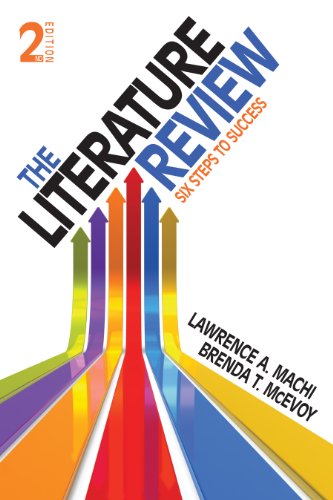
The literature review : six steps to success / Lawrence A. Machi, Brenda T. McEvoy.
Material type: TextPublication details: Thousand Oaks, Calif. : Corwin Press, c2012.Edition: 2nd edDescription: xx, 174 p. : ill. ; 23 cmISBN:
 - 9781452240886 (pbk. : alk. paper)
- 001.42 MAC M 23
- LB1047.3 .M33 2012
| Cover image | Item type | Current library | Home library | Collection | Shelving location | Call number | Materials specified | Vol info | URL | Copy number | Status | Notes | Date due | Barcode | Item holds | Item hold queue priority | Course reserves | |
|---|---|---|---|---|---|---|---|---|---|---|---|---|---|---|---|---|---|---|
| Stack text books | All India Institute of Speech and Hearing | 1/3 | 001.42 MAC M (Browse shelf(Opens below)) | Available | 19865 |
Includes bibliographical references (p. 167) and index.
Preface
New to This Edition
Audience
Special Features and Text Organization
Acknowledgments
About the Authors
Introduction
Key Vocabulary
The Purpose of a Literature Review
The Literature Review Defined
The Literature Review Process
Step 1. Select a Topic
Step 2. Search the Literature
Step 3. Develop the Argument
Step 4. Survey the Literature
Step 5. Critique the Literature
Step 6. Write the Review
Inquiry: The Necessary Precondition
Ethics
Pack Wisely Before You Begin
Tips
Summary
Checklist
Chapter 1: Step 1. Select a Topic
Key Vocabulary
Task 1. Choose a Research Interest
Exercises
Researcher Bias
Task 2. Refine a Research Interest From a Personal Interest
Activity 1. Specifying a Research Interest
Activity 2. Focusing the Interest
Activity 3. Selecting a Perspective
Activity 4. Reflection: The Key to Interest Selection
Task 3. Using the Research Interest to Identify a Preliminary Research Topic
Rules for Library Use
Task 4. Write the Preliminary Research Topic Statement
Tips
Summary
Checklist
Chapter 2: Step 2. Search the Literature
Key Vocabulary
Task 1. Select the Literature to Review
Task 2. Conducting a Literature Search
Activity 1. Managing Your Data
Activity 2. Scanning the Literature
Activity 3. Skimming the Literature
Activity 4. Mapping Your Materials
Activity 5. Creating Subject Memoranda
Task 3. Refine Your Topic
Tips
Summary
Checklist
Chapter 3: Step 3. Develop the Argument
Key Vocabulary
Concept 1. Building the Case for a Literature Review
Concept 2. Arguments-the Basics
Concept 3. Evaluating the Basic Parts of an Argument
Concept 4. Understanding Claims
Claims
Claim Acceptability
Concept 5. Building Evidence
Data Versus Evidence
Data Quality
Data Relevance
Qualifying the Claim
Concept 6. Warrants-Logically Connecting the Evidence to the Claim
Concept 7. Multiple Claims Arguments
Tips
Summary
Checklist
Chapter 4: Step 4. Survey the Literature
Key Vocabulary
Task 1. Assemble the Collected Data
Activity 1. Cataloging the Data
Task 2. Organize the Information
Activity 1. Arranging Information to Build Evidence
Activity 2. Organizing the Information and Building Claims
Task 3. Analyze the Patterns of the Data
Complex Reasoning
Comparative Reasoning
Building the Discovery Argument: An Example
Activity 1. Mapping the Argument of Discovery
Activity 2. Analyzing the Argument
Tips
Summary
Checklist
Chapter 5: Step 5. Critique the Literature
Key Vocabulary
Concept 1. Implicative Reasoning
Concept 2. The Two Arguments
Concept 3. Argument Patterns
Concept 4. Backing
Concept 5. Fallacies
Concept 6. The Case Is Everything
Tips
Summary
Checklist
Chapter 6: Step 6. Write the Review
Key Vocabulary
The Writing Process: Overview
Task 1. Write to Understand
Activity 1. Reviewing Notes and Memoranda
Activity 2. Exploratory Writing
Activity 3. Outlining
Activity 4. Preliminary Drafting
Task 2. Write to Be Understood
Activity 1. Writing the First Draft
Activity 2. Working With the Second and Third Drafts
Activity 3. Completing the Final Draft
Style Manuals
Tips on Writing
Last Words
Glossary
References and Further Reading
Index
There are no comments on this title.