
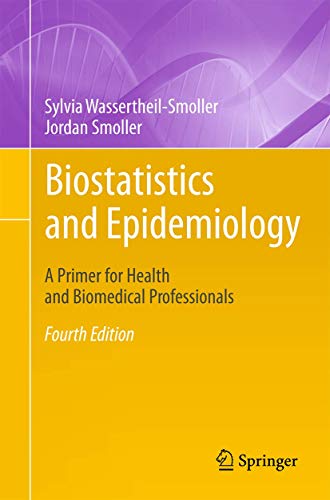
Biostatistics and epidemiology : a primer for health and biomedical professionals / Sylvia Wassertheil-Smoller, Jordan Smoller
Material type: TextPublisher: New York : Springer, [2015]Edition: Fourth editionDescription: xx, 260 pages : illustrations (some color), portraits ; 20 cmContent type:
 - text
- unmediated
- volume
- 9781493921331
- 1493921339
- 614.407 2 WAS S 23
| Cover image | Item type | Current library | Home library | Collection | Shelving location | Call number | Materials specified | Vol info | URL | Copy number | Status | Notes | Date due | Barcode | Item holds | Item hold queue priority | Course reserves | |
|---|---|---|---|---|---|---|---|---|---|---|---|---|---|---|---|---|---|---|
| Reference text books | All India Institute of Speech and Hearing | R-29/1 | 614.407 2 WAS S (Browse shelf(Opens below)) | Available | 23355 |
Includes bibliographical references and index.
The Scientific Method -- Probability -- Statistics -- Epidemiology.-Screening -- Clinical Trials -- Quality of Life -- Genetic Epidemiology -- Risk Prediction and Reclassification -- Research Ethics and Statistics -- Postscript -- Appendix A -- Appendix B -- Appendix C -- Appendix D -- Appendix E -- Appendix F -- References -- Suggested Readings -- Index.
Since the publication of the first edition, Biostatistics and Epidemiology has attracted loyal readers from across specialty areas in the biomedical community. Not only does this textbook teach foundations of epidemiological design and statistical methods, but it also includes topics applicable to new areas of research. Areas covered in the fourth edition include a new chapter on risk prediction, risk reclassification and evaluation of biomarkers, new material on propensity analyses, and a vastly expanded chapter on genetic epidemiology, which is particularly relevant to those who wish to understand the epidemiological and statistical aspects of scientific articles in this rapidly advancing field. Biostatistics and Epidemiology was written to be accessible for readers without backgrounds in mathematics. It provides clear explanations of underlying principles, as well as practical guidelines of "how to do it" and "how to interpret it." Key features include a philosophical explanation of the logic of science, subsections that can stand alone or serve as reference, cross-referencing, recommended reading, and appendices covering sample calculations for various statistics in the text. -- Source other than Library of Congress.
There are no comments on this title.