
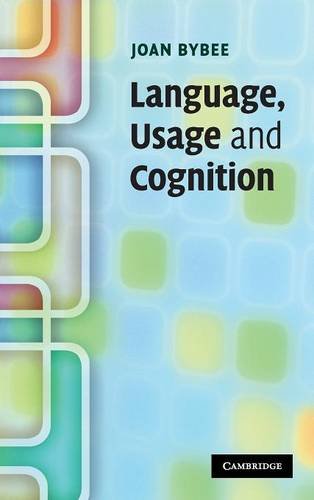
Language, usage and cognition / Joan Bybee.
Material type: TextPublication details: Cambridge ; New York : Cambridge University Press, 2010.Description: ix, 252 p. : ill. ; 23 cmISBN:
 - 9780521851404 (hbk.)
- 0521851408 (hbk.)
- 9780521616836 (pbk.)
- 0521616832 (pbk.)
- 415.BYB 22
- P301 .B84 2010
| Cover image | Item type | Current library | Home library | Collection | Shelving location | Call number | Materials specified | Vol info | URL | Copy number | Status | Notes | Date due | Barcode | Item holds | Item hold queue priority | Course reserves | |
|---|---|---|---|---|---|---|---|---|---|---|---|---|---|---|---|---|---|---|
| Reference text books | All India Institute of Speech and Hearing | R-18/4 | 415 BYB (Browse shelf(Opens below)) | Available | 16965 |
Includes bibliographical references (p. 226-245) and index.
A usage-based perspective on language -- Rich memory for language : exemplar representation -- Chunking and degrees of autonomy -- Analogy and similarity -- Categorization and the distribution of constructions in corpora -- Where do constructions come from? : synchrony and diachrony in a usage-based theory -- Reanalysis or the gradual creation of new constructions? : the English auxiliary -- Gradient constituency and gradual reanalysis -- Conventionalization and the local vs. the general : modern English can -- Exemplars and grammatical meaning : the specific and the general -- Language as a complex adaptive system : the interaction of cognition, culture and use.
"Language demonstrates structure while also showing considerable variation at all levels: languages differ from one another while still being shaped by the same principles; utterances within a language differ from one another while exhibiting the same structural patterns; languages change over time, but in fairly regular ways. This book focuses on the dynamic processes that create languages and give them their structure and variance. It outlines a theory of language that addresses the nature of grammar, taking into account its variance and gradience, and seeks explanation in terms of the recurrent processes that operate in language use. The evidence is based on the study of large corpora of spoken and written language, what we know about how languages change, as well as the results of experiments with language users. The result is an integrated theory of language use and language change which has implications for cognitive processing and language evolution"--Provided by publisher.
There are no comments on this title.