
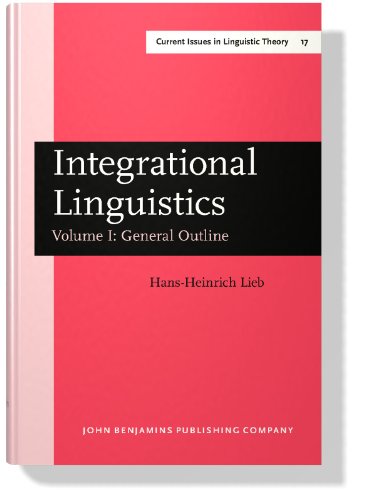
Integrational linguistics : General outline / Hans-Heinrich Lieb
Material type: TextPublication details: Amsterdam : John Benjamins 1983Description: V.1: 527 pISBN:
 - 9027235082
- 410 LIE
| Cover image | Item type | Current library | Home library | Collection | Shelving location | Call number | Materials specified | Vol info | URL | Copy number | Status | Notes | Date due | Barcode | Item holds | Item hold queue priority | Course reserves | |
|---|---|---|---|---|---|---|---|---|---|---|---|---|---|---|---|---|---|---|
| Stack text books | All India Institute of Speech and Hearing | 36/2 | 410 LIE (Browse shelf(Opens below)) | Available | 8137 |
Browsing All India Institute of Speech and Hearing shelves,Collection: 36/2 Close shelf browser (Hides shelf browser)


1. Dedication; 2. Acknowledgments; 3. General preface; 4. Table of contents; 5. 0 Introduction; 6. 1 Languages and their systems; 7. 2 idiolects and their systems; 8. Part B: Outline of syntax; 9. 3 Basic approach (1): A surface syntax for semantics; 10. 4 Basic approach (2): syntactic structures and syntactic functions; 11. 5 Syntactic structures (1): the constituent structure component; 12. 6 Syntactic structures (2): paradigms and syntactic marking categories; 13. 7 Syntactic structures (3): the marking structure component; 14. 8 Syntactic structures (4): intonation structures. The structure assignment; 15. 9 Constituent functions, category functions, accents; 16. Part C: Outline of morphology; 17. 10 Basic approach. Pure morphological constituent structures; 18. 11 Pure morphological marking structures and morphological intonation structures; 19. 12 morphological structures and morphological functions; 20. Part D: Outline of morphosemantics; 21. 13 Lexical meanings; 22. 14 the basis for morphosemantic meaning composition; 23. 15 morphosemantic meaning composition; 24. Part E: Outline of syntactic semantics (1): syntactic meanings; 25. 16 Lexical meanings in syntax; 26. 17 Sentence meanings; 27. 18 referential meanings and reference bases; 28. Basic, intermediate, and complete syntactic meanings; 29. Part F: Outline of syntactic semantics (2): meaning composition; 30. 20 intermediate syntactic meanings; 31. 21 predication bases; 32. 22 predication bases and semantic roles; 33. 23 predication; 34. 24 Predication, neagtion, and accents; 35. 25 Potential rhemata and potential rhematic background; 36. 26 Referential meanings and potential thematic parts; 37. 27 The construction of sentence meanings; 38. Part G: Integrational grammars; 39. 28 Theory integration (1): theories of language; grammars of languages and varieties; 40. 29 theory integration (2): idiolect grammars; non-linguistic theories; 41. 30 Integrational grammars as axiomatic theories; 42. Bibliographies; 43. List of references; 44. Bibliography of integrational linguistics; 45. Indexes; 46. Index of names; 47. Index of extratheoretical terms and subject; 48. Index of theoretical terms and subjects; 49. Lists; 50. Notational conventions; 51. List of symbols; 52. List of variables; 53. List constants
There are no comments on this title.