
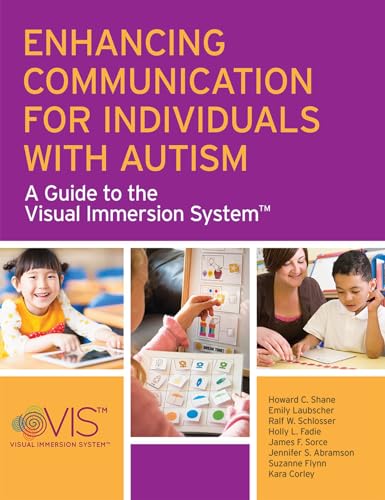
Enhancing communication for individuals with autism : a guide to the visual immersion system / by Howard C. Shane, Ph.D. [and seven others].
Material type: TextPublisher: Baltimore : Paul H. Brookes Publishing Co., [2015]Copyright date: ©2015Description: 326 pages : illustrations ; 28 cmContent type:
 - text
- unmediated
- volume
- 9781598572216 (paperback)
- 1598572210 (paperback)
- 618.928 588 2 SHA;2 23
- RJ506.A9 S519 2015
- EDU026000 | LAN018000 | MED007000
| Cover image | Item type | Current library | Home library | Collection | Shelving location | Call number | Materials specified | Vol info | URL | Copy number | Status | Notes | Date due | Barcode | Item holds | Item hold queue priority | Course reserves | |
|---|---|---|---|---|---|---|---|---|---|---|---|---|---|---|---|---|---|---|
| Stack text books | All India Institute of Speech and Hearing | 104/3 | 618.928 588 2 SHA;3 (Browse shelf(Opens below)) | Available | 20460 | |||||||||||||
| Reference text books | All India Institute of Speech and Hearing | R-64/4 | 618.928 588 2 SHA (Browse shelf(Opens below)) | Available | 20238 | |||||||||||||
| Stack text books | All India Institute of Speech and Hearing | 104/3 | 618.928 588 2 SHA;1 (Browse shelf(Opens below)) | Available | 20458 | |||||||||||||
| Stack text books | All India Institute of Speech and Hearing | 104/3 | 618.928 588 2 SHA;2 (Browse shelf(Opens below)) | Available | 20459 |
Includes bibliographical references (pages 303-310) and index.
Machine generated contents note: About the Authors -- Howard C. Shane, Ph.D., Emily Laubscher, M.S., CCC-SLP, Ralf W. Schlosser, Ph.D., Holly L. Fadie, M.S., CCC-CLP, James F. Sorce, Ph.D., Jennifer S. Abramson, M.S., CCC-CLP, Suzanne Flynn, Ph.D., CCC-CLP, and Kara Corley, M.S., CCC-CLP -- About the Downloadable Material -- Foreword -- Preface -- Acknowledgements -- Overview of The Visual Immersion Program (VIP) Language Acquisition and Symbolic Competence Tools Used to Support Visual Language and Communication Principles of Assessment Principles of Intervention Protesting Organization and Transitions Requesting Directives Commenting Questions Social Pragmatics Index.
"How can you help children with moderate to severe autism become more effective communicators? Discover the Visual Immersion System (VIS), a practical, research-based intervention framework that taps into the strong visual processing skills many children on the spectrum have. You'll learn how to use readily available resources from photos and symbols to apps and software to create a customized system of visual supports that boost seven key communicative functions (see sidebar). For each of the functions, you'll get comprehensive how-to guidance on choosing tools and materials, conducting systematic instruction, collecting data, and assessing how well interventions are working. A must for SLPs, interventionists, and educators, the innovative VIS approach will ensure better communication and higher quality of life for children with autism. WHY THE VIS WORKS: Uses visual supports, an approach that's proven successful for children with autism Strengthens communication skills needed for learning and meaningful human interaction Builds on evidence-based assessment and intervention procedures developed over decades at Boston Children's Hospital Incorporates a wide range of low-tech and higher-tech options Flexible can be used in home, school, or community settings Provides clear, easy-to-use instructions on conducting interventions Includes guidance on generalizing new communication skills PRACTICAL MATERIALS: Detailed guide to low- and higher-tech visual supports (includes benefits and limitations of each); case examples from clinical practice and field study; 15 reproducible checklists and forms to guide assessment, implementation, and progress monitoring. Help children with autism improve key communication skills: Protest and refusal Organization & transitions Requesting Directives Commenting Questions Social pragmatics"-- Provided by publisher.
"The Visual Immersion System (VIS) uses visual supports based on seven communicative operations: 1) Protest and refusal, 2) Transitions, 3) Requesting, 4) Commenting, 5) Directives, 6) Questions, and 7) Social pragmatics. For each of the seven functions, the book describes how to determine when to introduce that function, provide guidelines on how to prepare materials, outline how to conduct and improve instruction, and describe how to collect data and measure progress. Case examples from clinical practices as well as results from ongoing field study further illustrate how to generalize to the home and school environment. The final chapter will offer comparisons of VIP to other communication approaches. The accompanying downloads include photocopiable checklists and forms for assessment, implementation, and progress monitoring"-- Provided by publisher.
There are no comments on this title.