
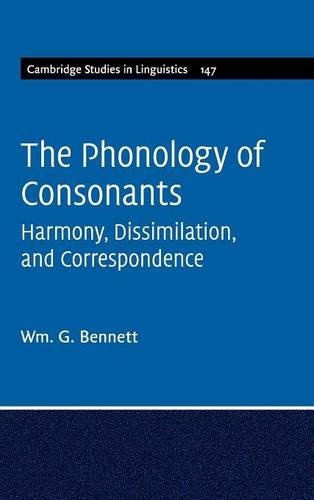
The phonology of consonants : harmony, dissimilation, and correspondence / W.M G. Bennett, Rhodes University, South Africa.
Material type: TextSeries: Cambridge Studies in Linguistics ; 147Publisher: Cambridge, United Kingdom : Cambridge University Press, 2015Description: xix, 394 pages : illustrations ; 24 cmContent type:
 - text
- unmediated
- volume
- 9781107073630 (Hardback)
- 414 BEN;1 23
- P235 .B46 2015
- LAN011000
| Cover image | Item type | Current library | Home library | Collection | Shelving location | Call number | Materials specified | Vol info | URL | Copy number | Status | Notes | Date due | Barcode | Item holds | Item hold queue priority | Course reserves | |
|---|---|---|---|---|---|---|---|---|---|---|---|---|---|---|---|---|---|---|
| Reference text books | All India Institute of Speech and Hearing | R-17/2 | 414 BEN (Browse shelf(Opens below)) | Available | 20593 | |||||||||||||
| Stack text books | All India Institute of Speech and Hearing | 37/2 | 414 BEN;1 (Browse shelf(Opens below)) | Available | 20594 |
Browsing All India Institute of Speech and Hearing shelves,Collection: 37/2 Close shelf browser (Hides shelf browser)

|

|

|

|

|
||
| 411 HES;1 Phonetic transcription in theory and practice / | 414 BEN;1 The phonology of consonants : | 414 BLA The acquisition of distinctive features / | 414 BYB Phonology and language use / | 414 EWE H The phonological structure of words : |
Includes bibliographical references (pages 376-387) and indexes.
Machine generated contents note: 1. Introduction; 2. The surface correspondence theory; 3. Kinyarwanda: the effects of domain edges, and the adequacy of a single SCorr relation; 4. Sundanese: complementary assimilation and dissimilation; 5. Quechua and Obolo: the role of syllable edges; 6. Chol and Ponapean: complete identity effects; 7. Zulu labial dissimilation: SCTD and the OCP; 8. Segmental blocking effects in dissimilation; 9. Typological survey of dissimilation; 10. Concluding remarks.
"The most comprehensive work on dissimilation (the avoidance or repair of combinations of similar sounds) to date, this book proposes a novel analysis that handles dissimilation as the avoidance of surface correspondence relationships. It draws on recent work in Agreement By Correspondence to show that dissimilation is a natural outcome predicted by the same theory of Surface Correspondence. The theory is developed in more detail than ever before, and its predictions are tested and evaluated through ten in-depth analyses of diverse languages from Quechua to Kinyarwanda, together with a typological survey of over 160 dissimilation patterns drawn from over 130 languages, from Acehnese to Zulu. The book redefines the core of Surface Correspondence theory to a level of formal specificity and theoretical precision surpassing previous work. The book's findings are made more accessible by numerous examples featuring data from 47 languages from around the world"-- Provided by publisher.
There are no comments on this title.