
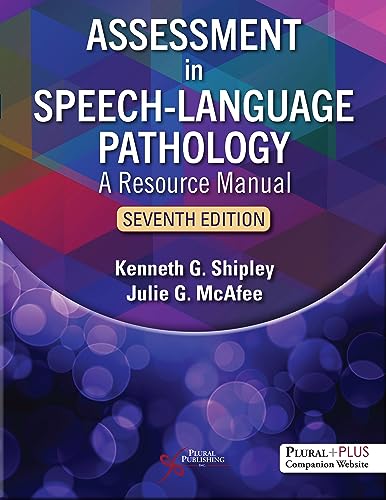
Assessment in speech-language pathology : a resource manual / Kenneth G. Shipley, Julie G. McAfee.
Material type: TextPublisher: San Diego, CA : Plural Publishing, Inc., [2025]Edition: Seventh editionDescription: xxiii, 660 pages : color illustrations ; 28 cmContent type:
 - text
- unmediated
- volume
- 9781635507102
- 1635507103
- 616.855 075 SHI M 23/eng/20230912
| Cover image | Item type | Current library | Home library | Collection | Shelving location | Call number | Materials specified | Vol info | URL | Copy number | Status | Notes | Date due | Barcode | Item holds | Item hold queue priority | Course reserves | |
|---|---|---|---|---|---|---|---|---|---|---|---|---|---|---|---|---|---|---|
| Reference text books | All India Institute of Speech and Hearing | R-39/2 | 616.855 075 SHI M (Browse shelf(Opens below)) | Available | 23981 | |||||||||||||
| Stack text books | All India Institute of Speech and Hearing | 66/4 | 616.855 075 SHI M;1 (Browse shelf(Opens below)) | Available | 23982 |
Includes bibliographical references and index.
List of Tables
List of Forms
List of Figures
Preface
Acknowledgments
Part I. Preparatory Considerations
Chapter 1. Foundational Information for Assessment in Speech-Language Pathology
Overview of Assessment
Professional Expectations for Clinicians
Code of Ethics
Code of Fair Testing Practices in Education
Health Insurance Portability Accountability Act (HIPAA)
Psychometric Principles
Validity
Reliability
Standardization
Sensitivity and Specificity
Freedom From Bias
Assessment Methods
Information From Clients and Others
Observation
Speech-Language Sample Analysis
Dynamic Assessment
Standardized Tests
Administering and Interpreting Standardized Tests
Accommodations and Modifications
Determining Chronological Age
Basals and Ceilings
Obtaining a Raw Score
Normative Data
Understanding Normed Scores
Confidence Intervals
Concluding Comments
Sources of Additional Information
Print Sources
Electronic Sources
Chapter 1 Forms
Chapter 2. Overview of a Complete Assessment
Elements of a Complete Assessment
Obtain a Case History
Allergy Awareness
Information From Other Professionals
Conduct an Intake Interview
Consider Internal and External Influences
Directly Assess the Client
Play-Based Assessment
Assimilate and Analyze Findings
Make a Diagnosis and Recommendations
Write a Diagnostic Report
IFSPs and IEPs
Writing SOAP Notes
Share Assessment Findings
Information-Sharing Meeting
Sharing Information Electronically
Assessment via Telepractice
Assessment Considerations Specific to Telepractice
Concluding Comments
Sources of Additional Information
Print Sources
Electronic Sources
Chapter 2 Forms
Appendix 2–A. Three Sample Clinical Reports
Appendix 2–B. Sample IFSP and IEP
Chapter 3. Multicultural Considerations
Cultural-Linguistical Knowledge
Cultural Communication Differences
Speech-Language Differences
Ethnographic Research
Cultural Competence
Assessment of CLD Clients
Language History
Direct Assessment
Disorder Versus Difference
Collaboration With Interpreters and Translators
Preassessment Preparation
Concluding Comments
Sources of Additional Information
Print Sources
Electronic Sources
Chapter 3 Forms
Appendix 3–A. Speech and Language Characteristics of African American English
Appendix 3–B. Speech and Language Characteristics of Spanish
Appendix 3–C. Speech and Language Characteristics of Asian Languages
Chapter 4. Hearing Considerations
Overview of Common Hearing Disorders
Audiograms
Standard Classification of Hearing Loss
Effects on Hearing Loss on Communication
The Speech Banana
Environmental Noise Levels
Hearing Aids
Troubleshooting Hearing Aid Problems
Hearing Screening as Part of a Speech-Language Assessment
Concluding Comments
Sources of Additional Information
Print Sources
Electronic Sources
Chapter 5. Medical and Psychiatric Conditions Associated With Communicative Disorders
Overview of Medical Conditions, Psychiatric Conditions, and Syndromes
Diagnoses, Descriptions and Clinical Significance
Acoustic Neuroma
Adenoidectomy
Allergy
Amyotrophic Lateral Sclerosis (ALS)
Angelman Syndrome
Ankyloglossia
Apert Syndrome
Aspiration Pneumonia
Attention-Deficit/Hyperactivity Disorder (ADHD)
Branchiootorenal Syndrome
Central Auditory Processing Disorder (CAPD)
Cerebral Palsy (CP)
CHARGE Syndrome
Congenital Rubella Syndrome (CRS)
Cornelia de Lange Syndrome|
Cerebrovascular Accident (CVA)
Convulsions
Coronavirus Disease 2019 (COVID-19)
Cri-du-Chat Syndrome
Crouzon Syndrome
DiGeorge Syndrome
Down Syndrome, Trisomy 21
Executive Function Deficit
Fetal Alcohol Spectrum Disorders (FASD)
Fragile X Syndrome (FXS)
Frontotemporal Dementia (FTD)
Huntington’s Disease (HD)
Learning Disability or Learning Disorder
Lewy Body Dementia (LBD)
Lou Gehrig’s Disease
Mastoiditis
Measles (Rubeola)
Ménière’s Disease
Meningitis
Myasthenia Gravis (MG)
Neurofibromatosis Type 2 (NF2)
Otitis Media
Parkinson’s Disease
Pierre Robin Sequence (PRS)
Polymicrogyria
Rubeola
Selective Mutism
Sotos Syndrome
Specific Learning Disorder (SLD)
Stickler Syndrome
Stroke
Tongue-Tie
Townes-Brocks Syndrome (TBS)
Transient Ischemic Attack (TIA)
Treacher Collins Syndrome
Trisomy 21 Syndrome
22q112 Deletion Syndrome
Usher Syndrome
Van der Woude Syndrome
Velocardiofacial Syndrome (VCFS)
Vestibular Schwannoma
Williams Syndrome
Concluding Comments
Sources of Additional Information
Print Sources
Electronic Sources
Part II. Resources for Assessing Communicative Disorders
Chapter 6. Common Assessment Procedures for Most Communicative Disorders
Standard Precautions
Common Intake Interview Questions
Orofacial Examination
Interpreting the Orofacial Examination
Assessing Diadochokinetic Syllable Rate
Speech-Language Sampling
Conversation Starters for Eliciting a Speech-Language Sample
Pictures
Narratives
Reading Passages
Evaluating Rate of Speech
Determining Speech Rate
Determining Intelligibility
Syllable-by-Syllable Stimulus Phrases
Charting Behaviors
Concluding Comments
Sources of Additional Information
Print Sources
Electronic Source
Chapter 6 Forms
Appendix 6–A. Pictures and Narratives With Pictures
Appendix 6–B. Reading Passages
Chapter 7. Assessment of Speech Sound Disorders
Overview of Assessment
Sounds in the English Language
Distinctive Features of Consonants
Phonological Processes
Developmental Norms for Phonemes and Consonant Clusters
Frequency of Occurrence of Consonants
Screening
Intake Interview Questions
Comprehensive Speech Sound Inventory
Formal Tests
Speech Sample Analysis
Intelligibility
Stimulability
Considerations for Diagnosis
Childhood Apraxia of Speech
Assessment Procedures for Childhood Apraxia of Speech
Concluding Comments
Sources of Additional Information
Print Sources
Electronic Sources
Chapter 7 Forms
Chapter 8. Assessment of Spoken Language in Children
Overview of Assessment
Five Language Domains
Typical Language Development
Piaget’s Stages of Early Cognitive Development
Development of Play
Language Disorder Descriptions
Screening
Intake Interview Questions
Comprehensive Language Assessment
Formal Assessment
Informal Assessment
Assessment for Early Intervention
Partnering with Parents
Late Talker Versus Language Disordered
Assessment of School-Age Children
Language Sample Analysis
Assessment of Morphologic Skills
Determine Mean Length of Utterance
Assessment of Semantic Skills
Assessment of Syntactic Skills
Assessment of Pragmatic Skills
Assessment of Narrative Skills
Considerations for Diagnosis
Concluding Comments
Sources of Additional Information
Print Sources
Electronic Sources
Chapter 8 Forms
Appendix 8–A. Motor and Communication Skills Sequence of Development
Chapter 9. Assessment of Written Language
Overview of Assessment
Role of the Speech-Language Pathologist
Multicultural Considerations
Typical Reading and Writing Development
Written Language Disability Characteristics and Types
Screening
Assessment of Reading
Phonological and Phonemic Awareness
Word Fluency
Reading Fluency
Informal Reading Inventories
Narrative Schema Knowledge
Assessment of Writing
Narrative Writing
Expository Writing
Persuasive Writing
Assessment of Spelling
Concluding Comments
Sources of Additional Information
Print Sources
Electronic Sources
Chapter 9 Forms
Chapter 10. Assessment for Autism Spectrum Disorder and Social Communication Disorder
Overview of Assessment
Definitions According to the DSM–5
Definition of Autism Spectrum Disorder
Definition of Social (Pragmatic) Communication Disorder
Role of the Speech-Language Pathologist
Typical Development of Social Language Skills
Early Indicators of a Pragmatic Language Disorder
Screening
Formal and Informal Assessment
Speech-Language Assessment
Standardized Language Assessment
Feeding Assessment
Considerations for Diagnosis
Concluding Comments
Sources of Additional Information
Print Sources
Electronic Sources
Chapter 10 Forms
Chapter 11. Assessment for Augmentative or Alternative Communication (AAC)
Overview of Assessment
Candidates for AAC
Types of AAC
Apps for AAC
Formal and Informal Assessment
Assess Sensory and Motor Capabilities
Assess Language and Cognitive Skills
Determine Communicative Needs
Select an Appropriate AAC System
Concluding Comments
Sources of Additional Information
Print Sources
Electronic Sources
Chapter 11 Forms
Chapter 12. Assessment of Fluency Disorders
Overview of Assessment
Types of Fluency Disorders
Stuttering
Cluttering
Screening
Intake Interview Questions
Speech Sampling
Disfluency Indexes
Secondary Behaviors
Associated Motor Behaviors
Physiologic Responses
Avoidance
Feelings and Attitudes
Speech Rate
Published Fluency Assessments
Considerations for Diagnosis
Diagnosing Stuttering
Diagnosing Cluttering
Stimulability
Concluding Comments
Sources of Additional Information
Print Sources
Electronic Sources
Chapter 12 Forms
Chapter 13. Assessment of Voice and Resonance
Overview of Assessment
Defining Voice and Resonance
Categories of Voice Disorders
The Multidisciplinary Team
Screening
Case History and Intake Interview Questions
Client History and Present Concerns
Perceptual and Instrumental Examination of Voice
Assessment of Pitch
Assessment of Vocal Intensity
Assessment of Vocal Quality
Assessment of Respiratory Support for Speech
Maximum Phonation Time
The S/Z Ratio
Assessment of Resonance
Auditory-Perceptual Assessment
Compensatory Articulation
Hardware and Software for Assessment of Voice and Resonance
Assessment of Alaryngeal Clients
Alaryngeal Communication Options
Assessment of Clients With Cleft Lip and/or Palate
Assessment of Transgender Clients
Concluding Comments
Sources of Additional Information
Print Sources
Electronic Sources
Chapter 13 Forms
Chapter 14. Assessment of Acquired Neurogenic Language Disorders
Overview of Assessment
The Brain
Setting-Specific Assessments
Outcome and Assessment Information Set (OASIS)
Minimum Data Set (MDS)
Functional Independence Measure (FIM)
Assessment of Clients With Aphasia
Assessment of Clients With Right Hemisphere Damage
Assessment of Clients With Traumatic Brain Injury
Assessment of Clients With Dementia
Concluding Comments
Sources of Additional Information
Print Sources
Electronic Sources
Chapter 14 Forms
Chapter 15. Assessment of Acquired Neurogenic Speech Disorders
Overview of Assessment
The Cranial Nerves
Assessment of Dysarthria
Assessment of Apraxia of Speech (AOS)
Differential Characteristics of Dysarthria and Apraxia of Speech
Concluding Comments
Sources of Additional Information
Print Sources
Electronic Sources
Chapter 15 Forms
Chapter 16. Assessment of Dysphagia
Overview of Assessment
Overview of a Normal Swallow
Typical Development of Feeding and Swallowing
Clinical Assessment of Pediatric Feeding and Swallowing
Case History
Alertness
Physiologic Status
Sucking Ability
Infantile Reflexes
Orofacial Structures and Function
Chewing and Swallowing Ability
Clinical Assessment of Adult Dysphagia
Case History
Orofacial Structures and Function
Chewing and Swallowing Ability
Graphic Imaging
Videofluoroscopy
Videoendoscopy
Concluding Comments
Sources of Additional Information
Print Sources
Electronic Sources
Chapter 16 Forms
References
Glossary
Index
"The book covers the diagnosis and evaluation of a wide range of communication disorders in adults and children"-- Provided by publisher.
There are no comments on this title.