
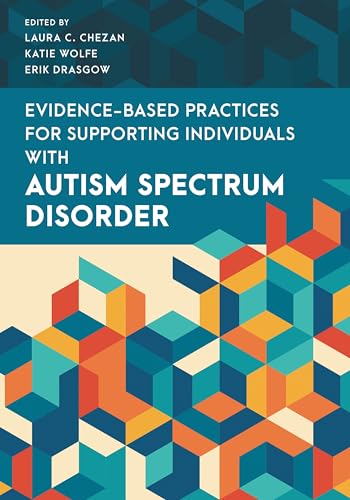
Evidence-based practices for supporting individuals with autism spectrum disorder / edited by Laura C. Chezan, Old Dominion University, Katie Wolfe, University of South Carolina, Erik Drasgow, University of South Carolina.
Material type: TextSeries: Special education law, policy, and practicePublisher: Lanham : Rowman & Littlefield, 2023Description: xix, 448 pages : illustrations ; 27 cmContent type:
 - text
- unmediated
- volume
- 9781538149263
- 616.858 82 CHE
| Cover image | Item type | Current library | Home library | Collection | Shelving location | Call number | Materials specified | Vol info | URL | Copy number | Status | Notes | Date due | Barcode | Item holds | Item hold queue priority | Course reserves | |
|---|---|---|---|---|---|---|---|---|---|---|---|---|---|---|---|---|---|---|
| Reference text books | All India Institute of Speech and Hearing | R-43/5 | 616.858 82 CHE (Browse shelf(Opens below)) | Available | 23546 |
Browsing All India Institute of Speech and Hearing shelves,Collection: R-43/5 Close shelf browser (Hides shelf browser)


Includes bibliographical references and index.
Preface
1 Quality of Life (Laura C. Chezan and Erik Drasgow)
Introduction and Overview
Defining Quality of Life
Historical Perspectives on Quality of Life
Promoting Quality of Life in Learners with ASD
Targeting Quality-of-Life Outcomes
Using Effective Quality-of-Life Planning
Assessing Quality-of-Life Outcomes
Quality of Life at Organizational and System Level
Summary
Application Activities
Additional Resources
2 Characteristics of Learners with Autism Spectrum Disorder (Katie Wolfe, Meka N. McCammon, and Aaron R. Check)
Introduction and Overview
Historical Context
Prevalence
Etiology
Genetic Influences
Environmental Influences
What About Vaccines?
Neurological Differences in Learners with ASD
Diagnostic Characteristics
Social Communication and Social Interaction
Restricted, Repetitive Patterns of Behavior, Interests, or Activities
Severity Level
Presence of Intellectual Disability
The Diagnostic Process
Surveillance
Screening
Diagnosis
Medical and Educational Diagnoses
Common Co-Occurring Conditions
Summary
Application Activities
Additional Resources
3 Assessment for Instructional Planning (Laura C. Chezan and Erik Drasgow)
Introduction and Overview
Assessment and Instructional Planning
Program Development
Progress Monitoring
Evaluation of Instructional Effectiveness
Characteristics of Assessment for Learners with ASD
Focus on Meaningful Behaviors
Focus on Natural Environments
Focus on Cultural Responsiveness
Multiple Sources of Information
Comprehensive Assessment
Assessment Methods
Indirect Methods: Interviews and Rating Scales
Direct Methods: Naturalistic Observation
Types of Assessment to Inform Program Development
Task-Analytic Assessment
Ecological Inventory
Preference Assessments
Curriculum-Based Assessment
Curriculum-Based Measurement
Linking Assessment to Intervention
Prioritizing Behaviors from Assessment
Writing Measurable and Observable Instructional Objectives
Summary
Application Activities
Additional Resources
4 Evidence-Based Practice: Finding the Right Treatment that Works (Susan M. Wilczynski, Abby Magnusen, Shawnna Sundberg, and Ben Seifert)
Introduction and Overview
Finding Evidence-Based Practices
Core Elements and Evidence-Based Practices
Core Element: Reinforcement
Core Element: Prompting
Task Analysis
EBP—Combining Core Elements: Chaining
EBP—Combining Core Elements: Modeling and Video Modeling
EBP—Individual and Group Applications: Token Economy
EBP—Individual and Group Applications: Visual Supports
The Evidence-Based Intervention Selection Model: Reminder and Application
Background
Step 1: Questions to Initiate the Evidence-Based Treatment Selection Process
Step 2—Part 1: Best Available Evidence
Step 2—Part 2: Person-Related Variables
Step 2—Part 3: Contextual Variables
Step 3: Professional Judgment
Step 4: Intervention Selection
Step 5: Intervention Implementation and Data Collection
Step 6: Reevaluation
Summary
Application Activities
Additional Resources
Notes
5 Implementation of Evidence-Based Practices (Rose A. Mason, Emily Gregori, Jennifer Elaine Smith, Amanda Austin, and Hannah Crosley)
Introduction and Overview
Effective Professional Development
Coaching
Collaborative Partnership
Needs Assessment
Developing Shared Goals
The Action Plan
Focused Observation
Reflection and Feedback
Behavior Skills Training
Preparing to Implement Behavior Skills Training
Implementing Behavior Skills Training
Additional Training Procedures
Self-Monitoring
In Vivo Coaching
Technology to Enhance Delivery of Training
Telepractice
Considerations for Training Other Practitioners
Teachers
Paraeducators
Related-Service Providers
Parents
Summary
Application Activities
Additional Resources
6 Progress Monitoring and Data-Based Decision Making (Katie Wolfe, Meka N. McCammon, and Aaron R. Check)
Introduction and Overview
Collecting Data
Identifying the Behavior or Skill
Operationally Defining the Behavior or Skill
Selecting a Data-Collection Method to Record Real-Time Data
Determining When to Collect Data
Developing a Data Collection Sheet
Training Others Who May Collect Data
Collecting Baseline Data
Developing an Objective
Graphing Data
Parts of a Line Graph
Creating Line Graphs
Analyzing Data
Making Data-Based Decisions
Patterns of Performance and Corresponding Decisions
Implementing Data-Based Decision Making
Case Study
Summary
Application Activities
Additional Resources
7 Ethics and Evidence-Based Practice: An Important Partnership for Meaningful Outcomes (Ilene S. Schwartz, Elizabeth M. Kelly, and Kaitlin Greeny)
Introduction and Overview
Brief History of Ethics
Professional Ethics
Evidence-Based Practices
Effectiveness in the Moment
Intersectionality
Basic Ethical Considerations
Competency
Confidentiality
Accountability
An Ethical Decision-Making Model
Step 1. Clarify the Problem
Step 2. Brainstorm Possible Solutions
Step 3. Evaluate Possible Solutions
Step 4. Propose an Acceptable Solution
Step 5. Implement the Solution and Document All Actions Taken
Step 6. Reflect Upon the Results of the Decision
Summary
Application Activities
Additional Resources
Note
8 Evidence-Based Practices to Enhance Social Competence (Jeff Sigafoos, Amarie Carnett, Mark F. O’Reilly, and Giulio E. Lancioni)
Introduction and Overview
Defining Social Competence
Social Skills
Foundational Social-Communication Skills
Requesting and Rejecting
Teaching Attention-Gaining Skills
Teaching Greeting Skills
Teaching Conversational Skills
Teaching Joint Attention and Peer Interactions Skills
Summary
Case Study
Background
Step 1: Questions to Initiate the Data-Based Treatment Selection Process
Step 2—Part 1: Best Available Evidence
Step 2—Part 2: Person-Related Variables
Step 2—Part 3: Contextual Variables (Resource Constraints, Environmental Supports)
Step 3: Professional Judgment
Step 4: Intervention Selection
Step 5: Intervention Implementation and Data Collection
Step 6: Reevaluation
Application Activities
Additional Resources
9 Evidence-Based Practices to Teach Academic Skills (Veronica P. Fleury, Jenny R. Root, Kelly Whalon, Emily Stover, and Alice Williams)
Introduction and Overview
Considerations for Teaching Academic Skills
Description of Academic Achievement
Reading Achievement
Mathematics Achievement
Considerations for Designing Instruction
Determining What to Teach
Follow the 3 P’s
Address Stages of Learning
Evidence-Based Practices to Teach Reading and Mathematics Skills
Prompting
Time Delay
Visual Supports
Task Analysis
Explicit Instruction
Summary
Case Study
Background
Step 1: Questions to Initiate the Data-Based Treatment Selection Process
Step 2—Part 1: Best Available Evidence
Step 2—Part 2: Person-Related Variables
Step 2—Part 3: Contextual Variables (Resource Constraints, Environmental Supports)
Step 3: Professional Judgment
Step 4: Intervention Selection
Step 5: Intervention Implementation and Data Collection
Step 6: Reevaluation
Application Activities
Additional Resources
10 Evidence-Based Practices to Address Problem Behavior (Mandy Rispoli, Catharine Lory, Eric Shannon, and Charissa Voorhis)
Introduction and Overview
Functional Behavior Assessment
Identifying Target Behavior
Operationalizing Target Behavior
Indirect Assessment
Descriptive Assessment
Functional Analysis of Problem Behavior
Interpreting FBA Results and Developing a Summary Statement
Function-Based Intervention
Social Positive Reinforcement
Antecedent Strategies
Teaching Strategies
Consequence Strategies
Social Negative Reinforcement
Antecedent Strategies
Teaching Strategies
Consequence Strategies
Automatic Reinforcement
Antecedent Strategies
Teaching Strategies
Consequence Strategies
Multiply Maintained Problem Behavior
Evaluating Intervention Effectiveness
Fading Interventions
Summary
Case Study
Background
Step 1: Questions to Initiate the Evidence-Based Treatment Selection Process
Step 2—Part 1: Best Available Evidence
Step 2—Part 2: Person-Related Variables
Step 2—Part 3: Contextual Variables (Resource Constraints, Environmental Supports)
Step 3: Professional Judgment
Step 4: Intervention Selection
Step 5: Intervention Implementation and Data Collection
Step 6: Reevaluation
Application Activities
Additional Resources
11 Evidence-Based Practices for Secondary Transition Planning and Supports for Youth with Autism Spectrum Disorder (Anthony J. Plotner, Valerie L. Mazzotti, Stephen M. Kwiatek, Wen-hsuan Chang, Aaron R. Check, Abigail Mojica, and Charles Walters)
Introduction and Overview
Legislation Supporting Transition-Aged Youth with Disabilities
Secondary Transition and Working with Learners with Autism Spectrum Disorder
Secondary Transition Frameworks and Practices
Description of Secondary Transition Evidence-Based Practices and Predictors for Learners with ASD
Considerations for Practical Application of Secondary EBPs, RBPs, and Predictors
Summary
Case Study
Background
Step 1: Questions to Initiate the Evidence-Based Treatment Selection Process
Step 2—Part 1: Best Available Evidence
Step 2—Part 2: Person-Related Variables
Step 2—Part 3: Contextual Variables (Resource Constraints, Environmental Supports)
Step 3: Professional Judgment
Step 4: Intervention Selection
Step 5: Intervention Implementation and Data Collection
Step 6: Reevaluation
Application Activities
Additional Resources
12 Collaborative Partnerships: Parents and Families (Hedda Meadan and Jamie N. Pearson)
Introduction and Overview
Family Involvement and Engagement
Parents, Caregivers, and Families
Parents and Families from Diverse Backgrounds
Grounding Family Involvement and Engagement in Theory
Families with Children with Autism
Strategies for Building Effective Family-Practitioner Partnerships
Strategies to Enhance Family Involvement and Engagement
Implementing Evidence-Based Practices with Families
Evaluating Partnerships with Families
Summary
Application Activities
Additional Resources
13 Collaborative Partnerships: How and Why to Foster Professional Collaborations (Jennifer M. Asmus, Lindsay M. McCary, and Taylor P. Dorlack)
Introduction and Overview
The Professional as an Expert for Problem Solving in the School Setting
Perspectives on the Role the Professional Plays in Service Provision Outside of the School Setting
Historical Perspective on Professionals as Supports for Learners with ASD
Emergence and Evolution of a Problem-Solving Framework of EBP
PSTs and a Problem-Solving Model of EBP
Expanding Adoption and Implementation of a Problem-Solving Model
Setting the Course for Effective Professional Collaboration
Planning for Meaningful Collaboration in Schools
Evaluating Impact and Acceptability of Collaboration
Summary
Case Study
Application Activities
Additional Resources
Note
14 Final Remarks (Katie Wolfe, Laura C. Chezan, and Erik Drasgow)
Focusing on Quality of Life
Connecting Assessment and Intervention
Targeting Socially Valid and Functional Behaviors
Engaging in Ethical Practice
Collaborating with Others
Summary
References
Index
About the Editors and Contributors
"This book provides pre- and in-service educators and other practitioners working with learners with autism spectrum disorder with a user-friendly resource to assist them with the identification, selection, implementation, and evaluation of evidence-based practices. Throughout, the book highlights aspects related to training, ethical decision-making, ongoing assessment, data-based decision making, and collaboration with families and other professionals"-- Provided by publisher.
There are no comments on this title.