
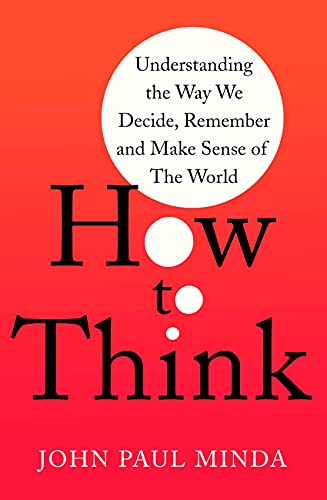
How to think : understanding the way we decide, remember and make sense of the world / John Paul Minda.
Material type: TextPublisher: London : Robinson, 2021Copyright date: ©2021Description: viii, 360 pages : illustrations ; 24 cmContent type:
 - text
- unmediated
- volume
- 9781472143037
- 1472143035
- 153 MIN 23
| Cover image | Item type | Current library | Home library | Collection | Shelving location | Call number | Materials specified | Vol info | URL | Copy number | Status | Notes | Date due | Barcode | Item holds | Item hold queue priority | Course reserves | |
|---|---|---|---|---|---|---|---|---|---|---|---|---|---|---|---|---|---|---|
| Literature books | All India Institute of Speech and Hearing | 153 MIN (Browse shelf(Opens below)) | Available | 23434 |
Browsing All India Institute of Speech and Hearing shelves Close shelf browser (Hides shelf browser)


Includes bibliographical references (pages 350-353) and index.
An introduction: About this book -- A history of cognitive psychology -- Understanding the brain -- Can you trust your senses? -- Attention: Why there's always a cost -- Memory: An imperfect process -- Working memory: A system for thinking -- Knowledge: The desire to know and explain -- Concepts and categories -- Language and thinking -- Thinking about cognitive bias -- Predicting the future -- Deducing the truth -- How we decide -- How to think.
We understand more about the brain than ever before and we also have more tools than ever before to help us think. This book will show you how your brain works, how your mind works, why we all make certain mistakes in thinking and why that's not always a bad thing. In order to understand how people behave, you need to understand how people think. And if you want to understand how people think, you need to have a basic understanding of cognitive psychology, cognitive science and cognitive neuroscience. This book explains cognition and the links between the brain, the mind and behaviour in a clear and straightforward way. Through interesting case studies and research examples, Minda shows how the brain is involved in mental activity, how memory works, how language affects thought, how good (and bad) decisions are made, and why we make predictable errors in our thinking. With practical applications for everyday life, this a book that helps us become better thinkers, better learners and better problem-solvers. In the current era of big data, algorithms and AI, Minda argues that knowing about how humans think-how you think-is more important than ever before.
There are no comments on this title.