
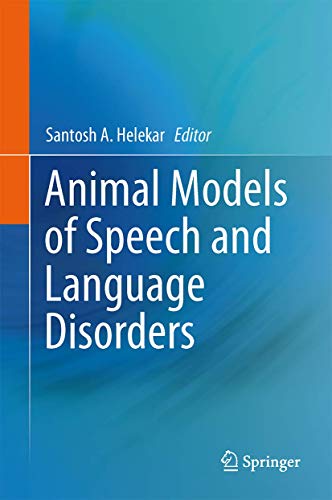
Animal models of speech and language disorders / Santosh A. Helekar, editor.
Material type: TextPublisher: New York ; Heidelberg : Springer, [2013]Copyright date: ©2013Description: x, 295 pages : illustrations (some color) ; 24 cmContent type:
 - text
- unmediated
- volume
- 9781461483991 (alk. paper)
- 1461483999 (alk. paper)
- 616.855 HEL; 1 23
- RC423 .A6 2013
| Cover image | Item type | Current library | Home library | Collection | Shelving location | Call number | Materials specified | Vol info | URL | Copy number | Status | Notes | Date due | Barcode | Item holds | Item hold queue priority | Course reserves | |
|---|---|---|---|---|---|---|---|---|---|---|---|---|---|---|---|---|---|---|
| Reference text books | All India Institute of Speech and Hearing | R-35/1 | 616.855 HEL (Browse shelf(Opens below)) | Available | 20419 | |||||||||||||
| Stack text books | All India Institute of Speech and Hearing | 52/3 | 616.855 HEL; 1 (Browse shelf(Opens below)) | Available | 20420 |
Includes bibliographical references and index.
Preface -- Section I . Introduction to Speech and Language Disorders -- Chapter 1. Neurology of Speech and Language Disorders -- Chapter 2. Genetic Pathways Implicated in Speech and Language -- Section II. Songbird Model of Vocal Learning -- Chapter 3. Time Scales of Vocal Learning in Songbirds -- Chapter 4. The Songbird Auditory System -- Chapter 5. Prospective: How the Zebra finch Genome Strengthens Brain-Behavior Connections in Songbird Models of Learned Vocalization -- Chapter 6. The Molecular Convergence of Birdsong and Speech -- Chapter 7. Stuttered Birdsong -- Section III. Mammalian Models of Vocal Communication -- Chapter 8. The Repertoire of Communication Calls Emitted by Bats and the Ways the Calls are Processed in the Inferior Colliculus -- Chapter 9. Language Parallels in New World Primates -- Chapter 10. Apes, Language and the Brain.
Animal Models of Speech and Language Disorders is arguably the first book that integrates several decades of research on the neuroscience and genetics of speech and language with behavioral, systems, cellular and molecular neurobiological studies on animal communication to create a synthesis of ideas with potential translational value in neurology, neurolinguistics and speech science. Speech and language dysfunctions plague a large segment of todays young and old alike because, besides being primary afflictions, they are also an integral part of the complex symptomatology of most of the common neurological and neurodevelopmental disorders, such as stroke, dementia, intellectual disability and autism. It is therefore essential that biomedical research be focused on understanding their neurobiological and genetic bases in order to have the chance of developing rational approaches to treating them. By weaving together findings from diverse disciplines in the comparative biology of vocal communication in songbirds, bats, New World monkeys and the great apes, with the applied and translational perspective in mind, this book attempts to create awareness among researchers and students about the strengths of the comparative and evolutionary approach to the scientific understanding of speech and language, and to addressing intractable clinical problems affecting higher brain functions. Animal Models of Speech and Language Disorders will be highly instructive to researchers, clinicians, advanced speech pathology and neuroscience students, and all those who are interested in the current state of knowledge in the basic and applied aspects of speech and language.-- Source other than Library of Congress.
There are no comments on this title.