
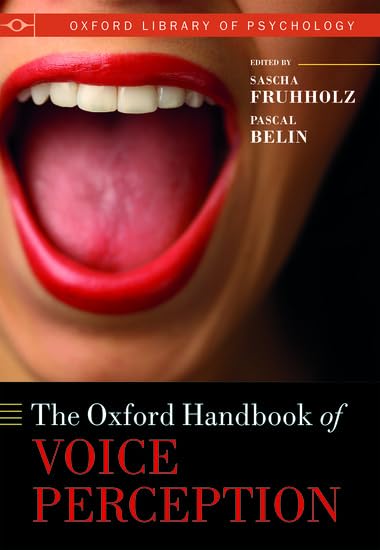
The Oxford handbook of voice perception / [edited by] Sascha Fruhholz, Pascal Belin.
Material type: TextSeries: Oxford handbooks ; olp:cPublisher: New York, NY : Oxford University Press, 2018Edition: 1st editionDescription: 939 pages ; 23 cmContent type:
 - text
- unmediated
- volume
- 9780198743187 (hbk.)
- 612.78 FRU B
| Cover image | Item type | Current library | Home library | Collection | Shelving location | Call number | Materials specified | Vol info | URL | Copy number | Status | Notes | Date due | Barcode | Item holds | Item hold queue priority | Course reserves | |
|---|---|---|---|---|---|---|---|---|---|---|---|---|---|---|---|---|---|---|
| Reference text books | All India Institute of Speech and Hearing | R-25/2 | 612.78 FRU B (Browse shelf(Opens below)) | Available | 22143 | |||||||||||||
| Stack text books | All India Institute of Speech and Hearing | 47/2 | 612.78 FRU B;1 (Browse shelf(Opens below)) | Available | 22144 |
Part I: The Voice is Special
1: Sascha Fruhholz and Pascal Belin: The science of voice perception
2: Diana Van Lancker Sidtis: Ancient of days: The vocal pattern as primordial big bang of communication
3: Pascal Belin: The "Vocal Brain": Core and extended cerebral networks for voice processing
4: Klaus Scherer: Acoustic patterning of emotion vocalizations
5: Yuanyuan Wang, Derek M. Houston, and Amanda Seidl: Acoustic properties of infant-directed speech
6: Johan Sundberg: The singing voice
7: Martin Meyer, Matthias Keller, and Nathalie Giroud: Suprasegmental speech prosody and the human brain: The acoustic and vocal features and the evolutionary architecture of the brain
8: Jody Kreiman, Bruce Gerratt: Reconsidering the nature of voice
Part II: Ontogenetic development of voice perception
9: Natacha Paquette, Emmanuelle Dionne-Dostie, Maryse Lassonde and Anne Gallagher: Voice perception in newborns and infants
10: Stefan Elmer, Eva Dittinger, and Mireille Besson: One step beyond: musical expertise and word learning
11: Evelyne Mercure and Laura Kischkel: Social perception in infancy: An integrative perspective on the development of voice and face perception
12: Katherine S. Young, Christine E. Parsons, Alan Stein, Peter Vuust, Michelle G. Craske, and Morten L. Kringelbach: Neural responses to infant vocalisations in adult listeners
Part III: Evolution and comparative perspective
13: Alan K.S. Nielsen and Drew Rendall: Comparative perspectives on communication in human and nonhuman primates: Grounding meaning in broadly conserved processes of voice production, perception, affect and cognition
14: Samantha Carouso Peck and Michael H. Goldstein: Linking vocal learning to social reward in the brain: Proposed neural mechanisms of socially guided song learning
15: Catherine Perrodin and Christopher I. Petkov: Voice sensitive regions, neurons and multisensory pathways in the primate brain
16: Attila Andics and Tamas Farago: Voice perception across species
17: Charles T. Snowdon: Emotional and social communication in nonhuman animals
18: Josef P. Rauschecker: Dual stream models of auditory vocal communication
Part IV: Emotional and motivational vocal expression
19: Sascha Fruhholz and Leonardo Ceravolo: The neural network underlying the processing of affective vocalizations
20: Silke Paulmann and Sonja A. Kotz: The electrophysiology and time-course of processing vocal emotion expressions
21: Jocelyne C. Whitehead and Jorge L. Armony: Amygdala processing of vocal emotions
22: Kai Alter and Dirk Wildgruber: Laughing out loud! Investigations on different types of laughter
Part V: Vocal identity, personality, and the social context
23: Tyler K. Perrachione: Recognizing speakers across languages
24: Stefan R. Schweinberger and Romi Zaske: Perceiving speaker identity from the voice
25: Marianne Latinus and Romi Zaske: Perceptual correlates and cerebral representation of voices-identity, gender, and age
26: Phil McAleer and Pascal Belin: The perception of personality traits from voices
27: Katarzyna Pisanski and David R. Feinberg: Vocal attractiveness
28: Sarah Stevenage: Voice processing: Implications for earwitness testimony
29: Benjamin Kreifelts and Thomas Ethofer: Voices in the context of human faces and bodies
30: Patricia E.G. Bestelmeyer: Linguistic 'first impressions': Accents as cue to person perception
Part VI: Machine-based generation and decoding of voices
31: Hideki Kawahara and Verena Skuk: Voice morphing
32: Alessandro Vinciarelli: Machine-based decoding of voices and human speech
33: Maximilian Schmitt and Bjorn Schuller: Machine-based decoding of paralinguistic vocal features
34: Bernd J. Kroeger: Neurocomputational models of voice and speech perception
35: Keikichi Hirose: Voice and speech synthesis - highlighting control of prosody
36: Volker Dellwo, Peter French, and Lei He: Voice biometrics for forensic speaker recognition applications
Part VII: Clinical disorders
37: David I. Leitman and Sarah M. Haigh: Impairments in decoding vocal emotion in schizophrenia and bipolar disorder
38: Kristiina Kompus and Kenneth Hugdahl: Perception of voices that do not exist: Neuronal mechanisms in clinical and non-clinical hallucinations
39: Claudia Roswandowitz, Corrina Maguinnessa, and Katharina von Kriegstein: Deficits in voice-identity processing: Acquired and developmental phonagnosia
40: Jennifer L. Agustus, Julia C. Hailstone, and Jason D. Warren: Voice processing in dementia
There are no comments on this title.