
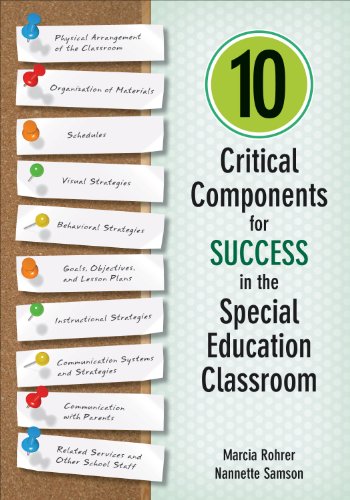
10 critical components for success in the special education classroom / Marcia Rohrer, Nannette Samson.
Material type: TextPublisher: Thousand Oaks, California : Corwin, [2014]Description: xvi, 213 pages ; 24 cmContent type:
 - text
- unmediated
- volume
- 9781483339160 (alk. paper)
- Ten criticial components for success in the special education classroom
- 371.904 3 ROH S 23
- LC3969.45 .R65 2014
| Cover image | Item type | Current library | Home library | Collection | Shelving location | Call number | Materials specified | Vol info | URL | Copy number | Status | Notes | Date due | Barcode | Item holds | Item hold queue priority | Course reserves | |
|---|---|---|---|---|---|---|---|---|---|---|---|---|---|---|---|---|---|---|
| Stack text books | All India Institute of Speech and Hearing | 19/3 | 371.904 3 ROH S (Browse shelf(Opens below)) | Available | 20568 |
Includes bibliographical references and index.
Preface
Acknowledgments
About the Authors
Introduction
1. Physical Arrangement of the Classroom
Rationale
Benefits of a Well-Designed Classroom
Well-Defined Areas Clarify Student Expectations
The 10-Minute Rule
Arranging Your Classroom
Required Areas
Home Base
Group Instruction Area
Teacher Work Area
Transition Area
Student Schedule Area
Work Station
Technology Area
Additional Areas
Arts and Crafts, Eating, and Cooking Areas
Personal Hygiene
Sensory Area
Recreation and Leisure Activity Area
Getting Started
Summary
Real-Life Applications
2. Organization of Materials
Rationale
Organizing Classroom Materials
What supplies will you need?
What stays and what goes?
Where will materials be located?
Group by academic subject
Group by frequency of use
Safety considerations
Organizing Student's Materials
Summary
Real Life Applications
3. Schedules
Rationale
The Three Types of Schedules
Building a Foundation for Your Schedules
Daily Classroom Schedule
Creating Your Classroom Schedule
Posting the Classroom Schedule
Using the Daily Classroom Schedule
Staff Assignment Schedule
Individual Student Schedules
The Importance of Symbolic Communication Forms
Creating Student Schedules
Student Schedule Formats and Locations
Teaching Students to Use Schedules
Summary
Real-Life Applications
4. Visual Strategies
Rationale
What Are Visual Strategies?
The Importance and Benefits of Visual Strategies
Creating Visual Strategies
Consider the Student's Communication Level
Using Visual Strategies
As Reminders
Schedules
Calendars
Behavioral Cues
Communication Supports
Summary
Real-Life Expectations
5. Behavioral Strategies
Rationale
Determing the Need for Behavioral Inteventions
Conducting a Functional Behavior Assessment
Define the Behavior
Gather Information About the Behavior
Review Records
Conduct Interviews
Collect Baseline Data
Look for Patterns of Behavior
Make a Hypothesis about the Function of the Behavior
Identifying Behavioral Goals and Objectives
Developing a Behavioral Intevention Plan
Defining Consequences
Meaningful Reinforcers
Edibles as Reinforcers
Nonedibles as Reinforcers
Punishment
Strategies to Change Behavior
Implementing the Behavioral Intervention Plan
Summary
Real-Life Applications
6. Goals, Objectives, and Lesson Plans
Rationale
Legal Foundation
Annual Goals and Objectives
Develop a Present Level of Academic Achievement
The Need for Data Collection
Methods for Collecting Data
Special Factors and the Individualized Education Program
Write the Annual Goals and Objectives
Lesson Plans
Lesson Plan Elements
Monitoring Student Progress: Your Grading System
Summary
Real-Life Applications
7. Instructional Strategies
Rationale
Instructional Considerations
Age-Appropriate Materials and Activities
Variety Increases Interest
Sensory Needs
Instructional Methods and Strategies
Direct Instruction
Applied Behavior Analysis
Grouping Students
Social Stories
Having a Substitute Teacher
Work Stations
Station Rotation
Community-Based Instruction
Summary
Real-Life Applications
8. Communication Systems and Strategies
Rationale
The Speech and Language Pathologist
Communication Throughout the Day
Teaching Social Skills
The Use of Schedules and Communication
Communication and Assistive Technology
Communication and Behavior
Summary
Real-Life Applications
9. Communication with Parents
Rationale
Setting Up a System for Parent Communication
Student-Generated Daily Communication to Parents
Keeping Communication Meaningful and Helpful
Documentation
Parental Involvement
Summary
Real-Life Applications
10. Related Services and Other School Staff
Rationale
Important Information About Related Services
Related Services Defined
Who Qualifies for Related Services?
Direct Versus Indirect Services
Service Delivery Models
Other School Staff
Summary
Real-Life Applications
Putting It All Together
Resources
Glossary and Acronym Guide
Forms
Index
There are no comments on this title.