
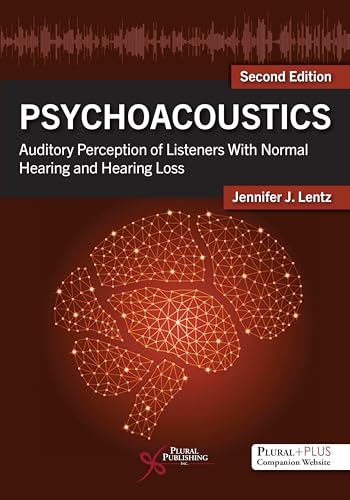
Psychoacoustics : auditory perception of listeners with normal hearing and hearing loss / Jennifer J. Lentz, PhD.
Material type: TextPublisher: San Diego, CA : Plural Publishing, Inc., [2025]Edition: Second editionDescription: xiii, 287 pages : illustrations ; 26 cmContent type:
 - text
- unmediated
- volume
- 9781635505252
- 612.85 LEN
| Cover image | Item type | Current library | Home library | Collection | Shelving location | Call number | Materials specified | Vol info | URL | Copy number | Status | Notes | Date due | Barcode | Item holds | Item hold queue priority | Course reserves | |
|---|---|---|---|---|---|---|---|---|---|---|---|---|---|---|---|---|---|---|
| Reference text books | All India Institute of Speech and Hearing | R-27/3 | 612.85 LEN (Browse shelf(Opens below)) | Available | 23514 | |||||||||||||
| Stack text books | All India Institute of Speech and Hearing | 52/1 | 612.85 LEN;1 (Browse shelf(Opens below)) | Available | 23515 |
Includes bibliographical references and index.
Introduction
Acknowledgements
Reviewers
Chapter 1. History
Learning Objectives
Introduction
Early Investigation of Perception
The Origins of Psychoacoustics
The Advent of the Telephone
Clinical Auditory Assessment
Pioneers in Auditory Perception: Women and Scientists of Color
References
Chapter 2. Estimating Threshold in Quiet
Learning Objectives
Introduction
Foundations of Absolute Threshold: Acoustics and Physiology
Measuring Thresholds
Auditory Thresholds in Adults
Summary and Take-Home Points
Exercises
References
Chapter 3. Estimating Thresholds in Noise (Masking)
Learning Objectives
Introduction
Acoustics: Noise and Filters
Physiological Factors
Introduction to Masking
The Critical Band and the Auditory Filter
The Excitation Pattern
Psychophysical Tuning Curves and Suppression
Masking by Fluctuating Sounds
Masking and Sensorineural Hearing Loss
Clinical Implications of Masking
Summary and Take-Home Points
Exercises
References
Chapter 4. Loudness and the Perception of Intensity
Learning Objectives
Introduction
Acoustics: Intensity and the Decibel
Physiological Representation of Stimulus Level
Loudness Perception
Calculating Loudness
Reaction Time as a Measure of Loudness
Intensity Discrimination
Effects of Sensorineural Hearing Loss on Loudness
Summary and Take-Home Points
Exercises
References
Chapter 5. Temporal Processing
Learning Objectives
Introduction
Temporal Resolution: Gap Detection
Temporal Resolution: Amplitude Modulation Detection
Temporal Masking
Comparison of Temporal Processing Measures
Temporal Integration
Effects of Sensorineural Hearing Loss on Temporal Processing
Auditory Neuropathy Spectrum Disorders (ANSD) on Temporal Processing
Summary and Take-Home Points
Exercises
References
Chapter 6. Pitch Perception
Learning Objectives
Introduction
Acoustics: Harmonic Complex Tones
Theories of Pitch Perception
Psychophysical Representations of the Place and Temporal Code
Pitch of Pure Tones
Pitch of Complex Sounds
Importance of Pitch Perception in Everyday Listening
Pitch Perception in Listeners With SNHL
Summary and Take-Home Points
Exercises
References
Chapter 7. Hearing with Two Ears
Learning Objectives
Introduction
Binaural Advantages to Detection and Discrimination
Localization in the Horizontal Plane
Sound Localization in the Median Plane
Lateralization
Binaural Unmasking
Impact of Sensorineural Hearing Loss on Binaural Hearing
Summary and Take-Home Points
Exercises
References
Chapter 8. Psychoacoustics and Advanced Clinical Auditory Assessment
Learning Objectives
Introduction
Dead Regions
Retrocochlear Assessment
Identification of Non-Organic Hearing Loss
Tinnitus Evaluation
Auditory Processing Disorder
Summary
Exercises
References
Chapter 9. Improving Auditory Perception for Listeners With Hearing Loss
Learning Objectives
Introduction
Conventional Hearing Aids
Cochlear Implants
Summary and Take-Home Points
Exercises
References
Glossary
Index
"Psychoacoustics: Auditory Perception of Listeners with Normal Hearing and Hearing Loss, Second Edition provides an overview of the field of psychoacoustics, with a primary focus on auditory perception. The influence of hearing loss on these general auditory abilities is discussed in every chapter. Components of the book also include the role of psychoacoustics in audiological assessment and treatment. Psychoacoustics is ideal for graduate students in audiology who intend on having a clinical career and need an understanding of both normal and impaired auditory perception. It is intended to give students sufficient information to understand how the ear achieves auditory perception, what the capabilities of the ear are, and how hearing loss influences that perception. It also provides students with a foundation for further study in the area and to apply psychoacoustic principles to diagnostic audiology and audiological rehabilitation"-- Provided by publisher.
There are no comments on this title.