
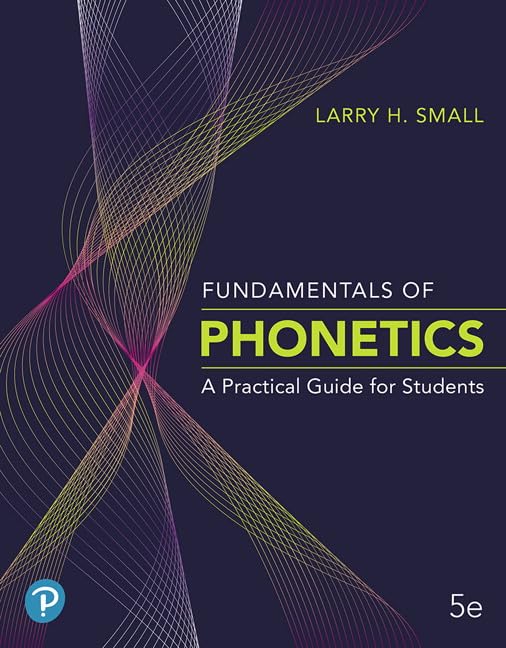
Fundamentals of phonetics : a practical guide for students / Larry H. Small.
Material type: TextPublisher: Boston : Pearson Education, Inc., [2018]Edition: Fifth editionDescription: xi, 395 pagesContent type:
 - text
- unmediated
- volume
- 9780135206492
- 0135206499
- 414.8 SMA 23
- PE1135 .S49 2018
| Cover image | Item type | Current library | Home library | Collection | Shelving location | Call number | Materials specified | Vol info | URL | Copy number | Status | Notes | Date due | Barcode | Item holds | Item hold queue priority | Course reserves | |
|---|---|---|---|---|---|---|---|---|---|---|---|---|---|---|---|---|---|---|
| Reference text books | All India Institute of Speech and Hearing | R-18/3 | 414.8 SMA (Browse shelf(Opens below)) | Available | 22360 | |||||||||||||
| Stack text books | All India Institute of Speech and Hearing | 38/1 | 414.8 SMA;1 (Browse shelf(Opens below)) | Available | 22361 |
Includes bibliographical references and index.
Phonetics: a "sound" science -- Phonetic transcription of English -- Anatomy and physiology of the speech mechanism -- Vowels -- Consonants -- Acoustic characteristics of vowels and consonants -- Connected speech -- Clinical phonetics: transcription of speech sound disorders -- Dialectal variation.
"Phonetics is the study of the production and perception of speech sounds. During your study of phonetics, you will begin to think about the process of speech production. You will learn how speech is formulated by the speech organs. You also will learn how individual speech sounds are created and how they are combined during the speech process to form syllables and words. You will need to learn to listen to the speech patterns of words and sentences to become familiar with the sounds of speech that comprise spoken language. A large part of any course in phonetics also involves how speech sounds are transcribed, or written. Therefore, you also will be learning a new alphabet that will enable you to transcribe speech sounds. This alphabet, the International Phonetic Alphabet (IPA), is different from most alphabets because it is designed to represent the sounds of words, not their spellings. Without such a systematic phonetic alphabet, it would be virtually impossible to capture on paper an accurate representation of the speech sound disorders of individuals seeking professional remediation. Using the IPA also permits consistency among professionals in their transcription of typical or atypical speech"-- Provided by publisher.
There are no comments on this title.